
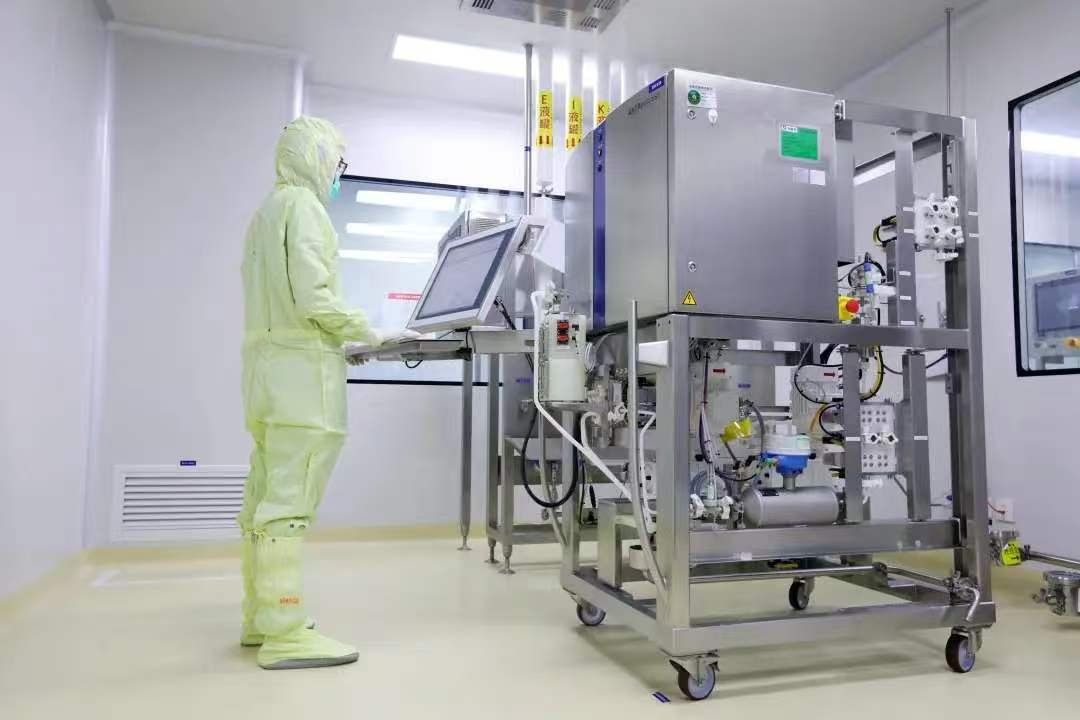
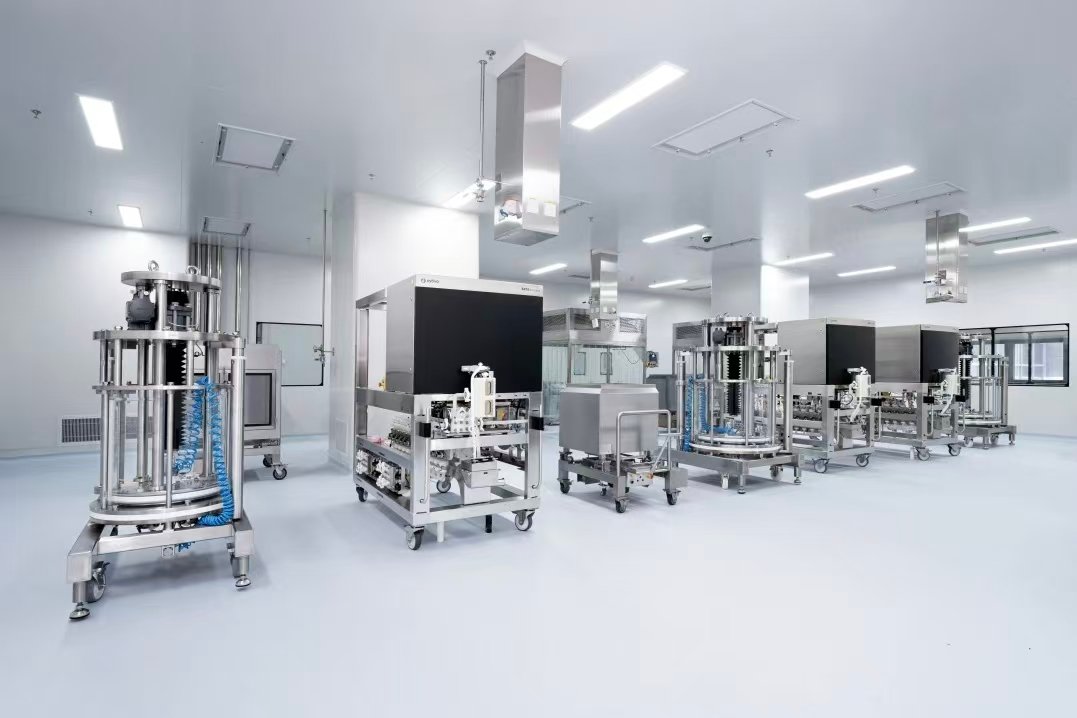
Similar to protein production, plasmid DNA process development generally commences with small-scale exploratory studies. The procedures encompass construction and selection of appropriate expression vectors and production microbial strains, optimization of fermentation conditions and cell growth parameters, as well as subsequent separation and purification operations. Following fermentation, a series of unit operations are implemented to eliminate diverse impurities. Cell lysis is succeeded by clarification and concentration steps, which serve to remove cell debris and structurally irrelevant contaminants including proteins and low-molecular-weight nucleic acids. Buffer exchange and volume concentration of plasmid DNA are also accomplished at this stage, laying a foundation for subsequent chromatographic purification. Chromatographic techniques are then adopted to isolate supercoiled plasmid DNA from structurally related impurities, such as relaxed and denatured plasmid DNA, genomic DNA (gDNA), high-molecular-weight RNA and endotoxins.
1. Cell Lysis
Cell lysis constitutes the initial critical step in plasmid DNA downstream processing and exerts a decisive impact on overall process recovery. Intracellular components including plasmid DNA, RNA, gDNA, endotoxins and proteins are fully released during lysis. Primary challenges in this procedure lie in the shear sensitivity of plasmid and genomic DNA molecules, as well as the high viscosity of lysate. Alkaline lysis, first proposed by Birnboim and Doly, has remained the predominant method for plasmid recovery.
Centrifugation is commonly applied in laboratory-scale alkaline lysis to separate solid precipitates containing cell debris, denatured proteins and nucleic acids under low-shear conditions. Nevertheless, this approach is not applicable to large-scale plasmid manufacturing. Industrial centrifuges operate with continuous feeding flow to achieve high throughput, and centrifugal acceleration generates shear force that damages precipitates and fragments gDNA. Consequently, filtration stands as the optimal technique for industrial-scale plasmid production. Filtration with 5 μm pore-size filters can remove 99% of precipitates formed after alkaline lysis, yielding a plasmid recovery rate of 67% and total DNA purity of 46%. Filters with pore sizes exceeding 15 μm fail to fully retain solid contaminants and thus cannot meet operational requirements. Filter aids are utilized in large-scale filtration to reduce pressure drop, preventing precipitate shear damage and redissolution of fragmented gDNA.
2. Clarification and Concentration
Most genomic DNA undergoes denaturation and precipitation during lysis, while plasmid DNA merely accounts for 2% (w/w) of total nucleic acids in Escherichia coli lysate. Residual abundant RNA and proteins require removal in subsequent procedures. Clarification and concentration are essential pretreatment steps to eliminate host proteins and nucleic acids prior to advanced purification. The core objective of clarification is high-molecular-weight RNA depletion. Endogenous nucleases present in lysate can degrade high-molecular-weight RNA; relevant research demonstrates that incubation of lysate at 37 °C reduces RNA content by 40% with only 9% plasmid loss.
Salting out with high-concentration chaotropic salts is a conventional industrial method for protein removal. Chaotropic salts such as lithium chloride and ammonium acetate can simultaneously precipitate high-molecular-weight RNA alongside proteins. Comparative studies on clarification of 4.8 kb plasmid extracts reveal no prominent superiority of lithium chloride in RNA elimination. Polyethylene glycol (PEG) precipitation is adopted post-clarification to further remove small nucleic acid fragments, reduce process volume, concentrate target products and complete buffer displacement ahead of chromatographic purification.
3. Purification of Supercoiled Plasmid DNA
Laboratory conventional purification methods including sucrose density gradient centrifugation and cesium chloride-ethidium bromide ultracentrifugation suffer from lengthy operation duration, poor scalability and toxic mutagenic reagents, which disqualify them from clinical-grade plasmid preparation. Chromatography has become the mainstream scalable technology for supercoiled plasmid purification. Based on interactions between nucleic acids and stationary phases, target plasmid DNA can be selectively separated from impurities according to molecular size, chemical properties including charge and hydrophobicity, base accessibility and topological constraints induced by supercoiled conformation.
3.1 Reversed-phase, Hydrophobic Interaction and Ion-pair Chromatography
Nucleic acid retention behavior in reversed-phase chromatography (RPC) and hydrophobic interaction chromatography (HIC) is governed by molecular size, base composition and secondary structure. Larger nucleic acid molecules exhibit longer retention time. AT-rich sequences tend to induce partial double-strand unwinding and single-strand exposure, enhancing hydrophobic interaction. Hence, single-stranded oligonucleotides show stronger retention than double-stranded DNA fragments of identical length. In ion-pair chromatography (IPC), partial denaturation of AT-rich DNA segments lowers charge density and weakens retention capacity. Supercoiled conformation generates torsional strain that strengthens binding affinity with stationary phases, resulting in prolonged retention along with increased supercoiling degree.
RPC and IPC are capable of isolating supercoiled plasmid DNA from crude lysate, achieving complete separation from low-molecular-weight RNA, gDNA fragments and linear plasmid DNA, among which linear plasmid presents the strongest retention. The major drawback of these techniques lies in the necessity of organic solvents for target elution.
3.2 Ion Exchange Chromatography
The polyanionic nature of nucleic acids enables purification via ion exchange chromatography (IEC). Elution order generally correlates positively with molecular size. Separation performance of IEC is conformation-dependent. Flexible nucleic acid chains fit pore curvature more readily, facilitating enhanced electrostatic interaction and higher retention factor. Molecular bending elevates local charge density and further intensifies binding force.
Anion exchange chromatography (AEC) is widely applied to separate relaxed and supercoiled plasmid topological isomers. Supercoiled DNA features compact conformation, superior ductility and bending property, contributing to higher charge density and better pore fitting capacity. Elution gradient length significantly affects resolution; optimal separation is achieved within 5 to 20 column volumes. Gentle gradient elution imposes negligible influence on small double-stranded DNA fragments yet benefits purification of high-molecular-weight nucleic acids and removal of miscellaneous contaminants. Mild sodium chloride gradient enables partial separation of relaxed, supercoiled and denatured plasmid DNA. However, single AEC procedure cannot accomplish selective elution and thorough purification of high-charge-density substances including plasmid DNA, gDNA, high-molecular-weight RNA and endotoxins.
3.3 Size-Exclusion Chromatography
Supercoiled conformation reduces the hydrodynamic radius of plasmid DNA. Size-exclusion chromatography (SEC) differentiates DNA molecules by dimensional discrepancy, meanwhile separating RNA, endotoxins, proteins and other small impurities. SEC is commonly implemented as a final polishing chromatographic step. High-molecular-weight gDNA and plasmid DNA are excluded from porous stationary phases and eluted earlier, whereas low-molecular-weight contaminants are retained inside column pores. Reduced sample concentration improves resolution between plasmid DNA and gDNA. Serial connected SEC columns extend effective separation length and enhance impurity separation efficiency, accompanied by unavoidable high sample dilution.
3.4 Affinity Chromatography
Triple helix structures can form within double-stranded DNA and maintain stability under high ionic strength. Triple helix affinity chromatography is developed based on specific binding between immobilized oligonucleotide ligands and complementary sequences on target plasmid molecules, displaying preferable affinity toward supercoiled plasmid conformation. This method can reduce RNA and gDNA contents to undetectable levels while maintaining 62% plasmid recovery rate. Nevertheless, it merely halves endotoxin content and triggers accumulation of denatured plasmid DNA. Combined with low binding capacity of chromatographic media, triple helix affinity purification fails to meet economic production requirements.
Conclusion
Growing market demand for supercoiled plasmid DNA drives continuous advancement and optimization of purification processes. Chromatographic techniques stand out for scalable manufacturability, excellent reproducibility, safe reagent application and compliance with industrial validation and rigorous cleaning standards. Anion exchange and hydrophobic interaction chromatography serve as optimal choices for initial capture, purification and concentration of supercoiled plasmid DNA. High-salt loading conditions effectively eliminate gDNA fragments, RNA, proteins and endotoxins. Final size-exclusion chromatography polishing is required to separate supercoiled plasmid from relaxed, linear and denatured isoforms, as well as to conduct buffer exchange for formulation and long-term storage.
As a leading process-oriented engineering company, Sino Bioengineering delivers professional bioengineering solutions and comprehensive technical services to clients worldwide.
For more products and solutions: https://sinobioengg.com/category/solution/
For more service: https://sinobioengg.com/category/service/