
Against the backdrop of a biopharmaceutical industry increasingly driven by high productivity, superior quality, expedited time-to-market, and cost reduction, conventional batch and fed-batch cultivation platforms are confronting mounting limitations. As demand accelerates for complex biologics—including monoclonal antibodies, bispecific antibodies, and gene therapy vectors—cell culture processes are progressively transitioning toward high cell density, high productivity, and continuous manufacturing (CM). However, perfusion operations are characterized by prolonged run times and intricate process dynamics, rendering them acutely sensitive to fluctuations in cellular state, nutrient availability, and metabolite accumulation. Conventional off-line analytics and empirical judgment alone can no longer deliver the resolution required for fine-grained process control.
Why PAT Is Indispensable to Perfusion Processes
As a cornerstone process route in modern biopharmaceutical manufacturing, perfusion enables high cell density cultivation and continuous production, offering distinct advantages in elevating volumetric productivity and enhancing product quality consistency. Yet, relative to fed-batch culture, perfusion entails considerably longer run durations and greater operational complexity, placing elevated demands on process control capability.
In this context, Process Analytical Technology (PAT) has emerged as a critical enabling technology underpinning the successful deployment and robust operation of perfusion processes.
01. Addressing the Inherent Latency of Off-line Monitoring in Complex Perfusion Operations
Traditional perfusion workflows rely on periodic sampling and subsequent off-line analysis, introducing inherent delays in data availability. By the time deviations become apparent, the cellular environment may already have shifted substantially.
PAT overcomes this limitation through on-line or at-line monitoring, enabling real-time acquisition of critical process data and immediate insight into bioreactor performance. This facilitates more rapid, accurate, and data-driven process decision-making.
02. Enabling Precise Process Control and CPP Optimization in High Cell Density Cultures
High cell density perfusion culture is accompanied by a marked increase in oxygen uptake rate (OUR), accelerated nutrient consumption, rapid accumulation of metabolic by-products, and a narrowed process operating window. Under such conditions, even minor perturbations can compromise cell viability and product expression.
PAT provides continuous, real-time monitoring of critical process parameters (CPPs)—including viable cell density, glucose concentration, lactate concentration, and dissolved CO₂ levels—thereby enabling precise regulation of the cultivation environment and sustaining cells in a stable, high-productivity state.
Multiple CPPs directly govern final product quality in perfusion, including perfusion rate, cell-specific perfusion rate (CSPR), feeding strategy, aeration conditions, and agitation intensity. Leveraging real-time feedback, PAT enables dynamic, closed-loop adjustment of these parameters.
03. Enhancing Product Quality Consistency
For biotherapeutics such as monoclonal antibodies, bispecific antibodies, and recombinant proteins, product quality is not determined solely by end-point testing but is shaped cumulatively throughout the entire cultivation process.
By enabling real-time monitoring of parameters correlated with critical quality attributes (CQAs), PAT shifts quality assurance upstream into the manufacturing process—fundamentally transitioning the paradigm from “testing for quality” to “building quality into the product.”
04. Establishing the Foundation for Smart Manufacturing and AI Deployment
Beyond its monitoring function, PAT serves as the primary data backbone for digitalization and intelligent manufacturing. Through the continuous accumulation of:
1. Process parameter data
2. Metabolic profiling data
3. Cell growth data
4. Product quality data
integrated with artificial intelligence (AI) and machine learning (ML) methodologies, PAT enables:
1. Process trend forecasting
2. Anomaly detection and early warning
3. Automated feeding control
4. Predictive process optimization
5. Digital twin model construction
Key Challenges of PAT Implementation in Perfusion Processes
Notwithstanding its substantial value, the deployment of PAT in perfusion operations is accompanied by formidable challenges. Compared with fed-batch processes, perfusion is distinguished by extended continuous operation, elevated cell densities, and frequent media exchange, which collectively impose more stringent requirements on the real-time responsiveness, robustness, and intelligence of PAT systems.
01. Measurement Accuracy at Ultra-High Cell Densities
Perfusion cultures routinely maintain cell densities ranging from tens of millions to over one hundred million cells per milliliter. Principal technical challenges include:
1. Sensor signal instability caused by cell aggregation
2. Severe light-scattering interference affecting spectroscopic PAT modalities (Raman, NIR)
3. Clogging of on-line sampling lines
4. Sensor fouling, which degrades measurement accuracy over extended operation
02. The Substantial Burden of Model Development and Validation
A core value proposition of PAT resides in data-driven state monitoring and quality prediction, enabled by models such as:
1. Raman spectroscopic calibration models
2. Soft sensor models
3. Quality prediction models
4. Machine learning models
However, model development typically demands:
1. Large volumes of historical batch data
2. Comprehensive coverage of diverse process operating conditions
3. Extended validation cycles and ongoing model maintenance
The Future Vision: AI + PAT + Perfusion Convergence
As the biopharmaceutical industry accelerates its transition toward continuous, digitalized, and intelligent manufacturing, perfusion has established itself as a pivotal enabling production technology, with PAT endowing processes with real-time sensing and situational awareness. In the foreseeable future, the deep convergence of artificial intelligence, PAT, and perfusion will bring the vision of a “smart bioreactor”—capable of autonomous learning, decision-making, and optimization—into tangible reality.
01. From “Observing the Process” to “Predicting the Future”
Augmented by AI, conventional PAT evolves into a predictive and autonomous framework. By interrogating historical batch records alongside real-time process streams, the system can anticipate in advance:
1. Cell growth trajectories
2. Nutrient consumption kinetics
3. Accumulation of metabolic by-products
4. Variations in product expression levels
5. Potential process deviation risks
02. Closed-Loop Control Becoming the Standard Paradigm
Future control architectures will progressively transition to: real-time PAT monitoring + AI-driven decision-making + automated control execution. A representative workflow includes:
1. Capacitance probe detecting a rapid rise in viable cell density
2. Raman spectroscopy identifying accelerated glucose consumption
3. AI computing the optimal cell-specific perfusion rate (CSPR)
4. The control system synchronously modulating perfusion rate and feed rate
03. Real-Time Release Testing (RTRT) Becoming Feasible
04. From Automation to Autonomous Production
Over the next decade, the developmental objective for bioreactors may shift decisively from “automation” to “autonomy,” with production systems capable of:
1. Automatically identifying cell growth phases
2. Autonomously optimizing cultivation strategies
3. Dynamically adjusting perfusion parameters
4. Independently detecting anomalous process states
5. Automatically generating comprehensive process reports
Conclusion
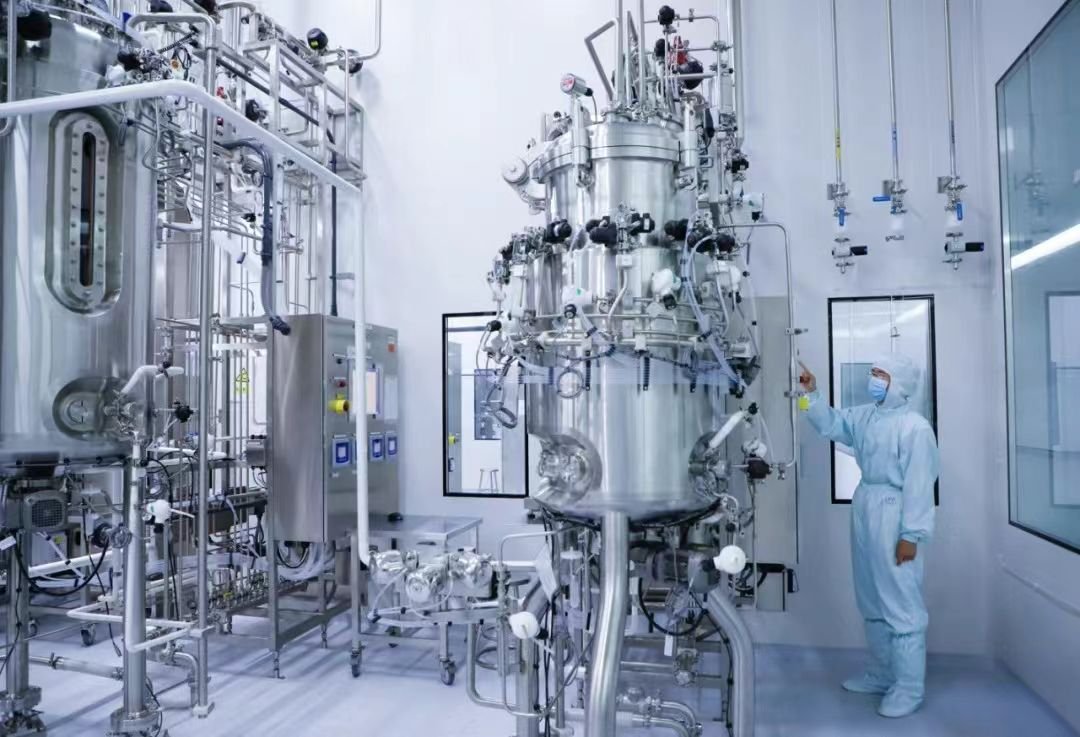
As the biopharmaceutical industry advances rapidly toward continuous manufacturing, high cell density cultivation, and digital production, perfusion processes impose increasingly rigorous requirements on process monitoring and intelligent control. As an advanced process solution developed by Sino Bioengineering, the APS (Advanced Process Solutions) platform—integrated with state-of-the-art bioreactors—consolidates on-line analytical technologies, data management infrastructure, and automated control capabilities, thereby providing a comprehensive and actionable PAT implementation pathway for perfusion processes.
The bioreactors of tomorrow will do more than sense cultivation events in real time; they will interpret process dynamics and proactively execute optimization decisions. Through PAT platforms exemplified by advanced bioreactors and the APS system, biopharmaceutical enterprises will be empowered to establish data-driven smart manufacturing ecosystems, thereby laying a robust foundation for continuous biomanufacturing and the construction of intelligent factories.