

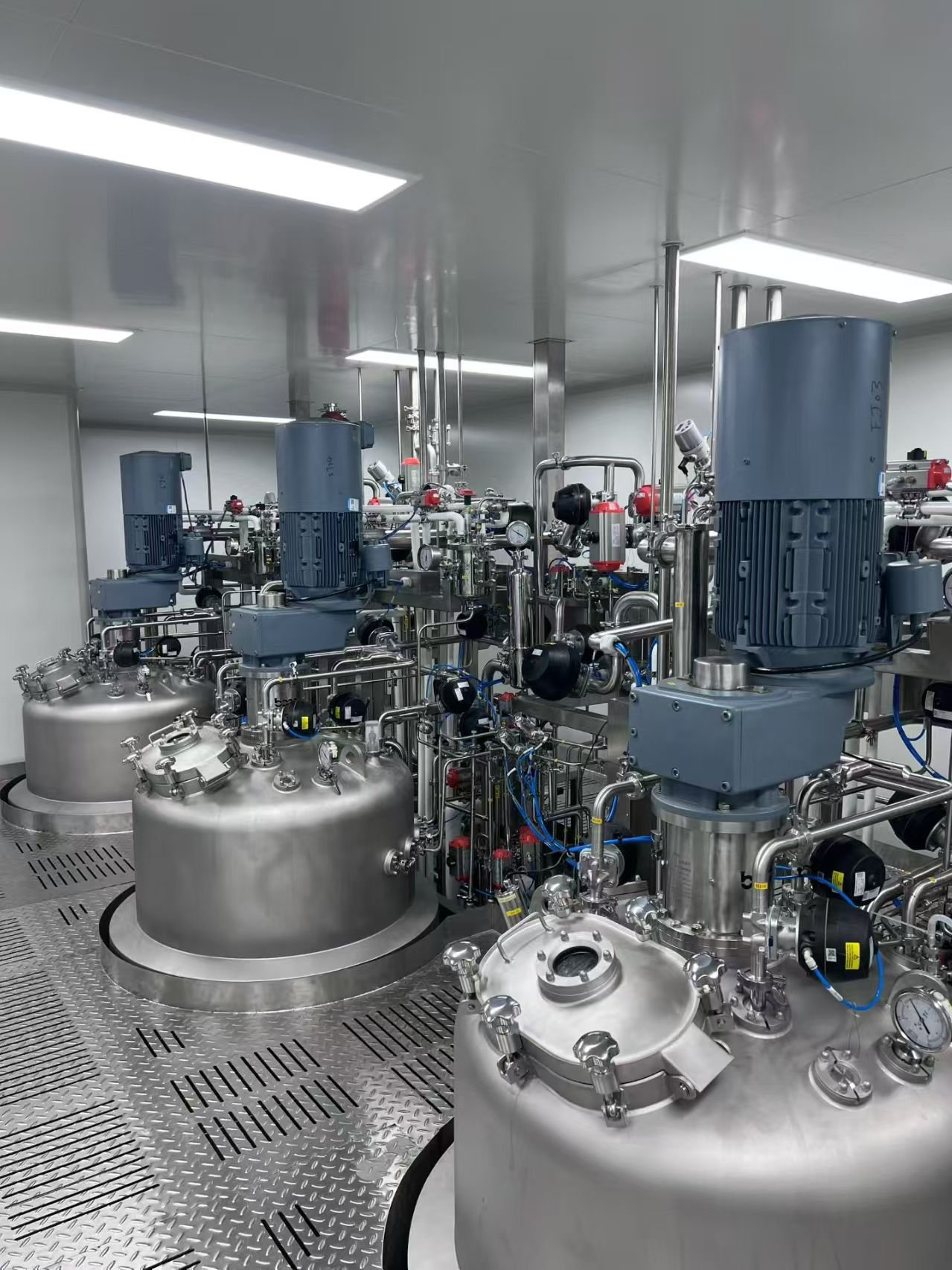
Mammalian cell culture is the core process for the production of monoclonal antibodies, recombinant proteins, viral vectors and other biopharmaceutical products. During the scale-up of bioreactors from laboratory scale to pilot and commercial production scale, high cell shear force generated by fluid turbulence, impeller agitation and aeration is one of the most critical problems causing cell damage, reduced cell viability, inhibited proliferation, and declined product quality and yield. Delicate mammalian cells without cell walls are extremely sensitive to mechanical shear stress, and unreasonable scale-up parameter settings will lead to massive cell death and batch production failure. This article systematically analyzes the causes of shear damage in mammalian cell scale-up culture, and proposes targeted optimization strategies from impeller configuration, agitation parameters, aeration conditions and tank pressure control, providing practical technical references for stable and high-yield scale-up culture of mammalian cells.
1. Introduction
Unlike microbial cells, mammalian cells are eukaryotic cells with weak mechanical resistance. Their plasma membrane is fragile and cannot withstand excessive fluid shear force, turbulent impact and bubble breaking stress. In small-scale laboratory bioreactors, the fluid flow field is uniform, the shear environment is mild, and cell growth is rarely affected by mechanical force. However, after scaling up the reactor volume, the traditional scale-up strategy based on constant power per unit volume or constant stirring speed will cause drastic changes in the internal flow field of the reactor.
Excessively high shear force will destroy the cell membrane structure, cause cell apoptosis and necrosis, reduce cell density and viability, and also affect cell metabolism and protein expression modification, resulting in increased product impurity content and decreased biological activity. Therefore, controlling shear stress within the safe tolerance range of mammalian cells is the key technical bottleneck to realize successful bioreactor scale-up. Combined with industrial practical application experience, this paper summarizes a full set of low-shear optimization schemes for mammalian bioreactor scale-up.
2. Core Causes of Cell Shear Damage During Bioreactor Scale-Up
Shear damage of mammalian cells in scaled-up bioreactors mainly comes from three sources. First, high-speed rotation of traditional impellers produces strong fluid shear and local turbulence, which continuously impacts and tears suspended cells. Second, excessive aeration rate and tiny broken bubbles generate interfacial shear force, causing cell damage during bubble rising and bursting. Third, the mismatch of stirring quantity, rotation speed and reactor volume leads to uneven mixing of the tank body, resulting in local high-shear dead zones or excessive turbulence areas. In addition, unreasonable tank pressure changes will affect bubble size and fluid stability, indirectly aggravating shear damage. All these factors are amplified in the scale-up process, leading to prominent cell damage problems.
3. Key Low-Shear Optimization Strategies for Mammalian Bioreactor Scale-Up
3.1 Customized Low-Shear Impeller Configuration
Impeller type is the decisive factor affecting the flow field and shear level inside the bioreactor. Traditional straight-blade turbine impellers have strong shear performance, which is suitable for microbial fermentation but extremely unfriendly to mammalian cell culture. For delicate mammalian cells, customized low-shear impellers are the primary optimization measure.
Marine impeller and Elephant Ear impeller are the two most mainstream low-shear impeller configurations for mammalian bioreactors. The Marine impeller adopts a streamlined curved blade design, which can produce axial dominant flow during rotation, realize rapid and uniform mixing of the culture medium with low turbulence intensity, and effectively reduce fluid shear force. The Elephant Ear impeller has a larger blade area and a more gentle arc structure, which further reduces local shear stress while maintaining excellent mixing efficiency. It can avoid cell extrusion and tearing caused by blade cutting and turbulent impact. In the scale-up process, customized impeller size, blade radian and installation spacing can be carried out according to the reactor diameter and liquid loading volume to match the low-shear mixing requirements of large-volume culture systems.
3.2 Rational Optimization of Agitation Speed
Stirring speed is the most intuitive parameter affecting shear force. The shear force inside the bioreactor is positively correlated with the stirring speed. In the scale-up process, blind pursuit of high mixing efficiency by increasing the speed will directly lead to massive cell shear damage. The core of speed optimization is to balance uniform mixing and low shear control.
For small-scale reactors, the stirring speed is relatively high due to the small liquid volume and short mixing path. After scale-up, the mixing radius and liquid circulation stroke increase, so the stirring speed must be appropriately reduced to avoid excessive linear velocity of the impeller tip. The scale-up principle of constant tip linear velocity or constant average shear rate can be adopted to calculate the optimal speed range. On the premise of ensuring no dead zone in the tank and uniform distribution of dissolved oxygen and nutrients, the minimum effective stirring speed is used to reduce the mechanical shear stress on cells.
3.3 Reasonable Matching of Stirring Quantity
In large-scale bioreactors with high liquid height, a single impeller cannot realize uniform mixing of the upper and lower liquid layers, which will lead to stratification of the culture medium, insufficient dissolved oxygen in the lower layer, and accumulation of metabolic waste. However, excessive number of impellers will increase the overall shear level of the system and produce overlapping turbulent shear zones.
Therefore, it is necessary to reasonably configure the number of stirring impellers according to the height-diameter ratio of the scaled-up reactor. For conventional mammalian cell bioreactors with a height-diameter ratio of 2:1 to 3:1, 2 to 3 low-shear impellers are usually configured. The installation spacing of impellers is strictly controlled to avoid excessive local turbulence caused by too small spacing and insufficient mixing caused by too large spacing. The matching of multiple impellers ensures the overall uniformity of the flow field while maintaining the low-shear environment of the whole system.
3.4 Precise Control of Aeration Rate
Aeration is the main way to supply dissolved oxygen for cell culture, but aeration shear is one of the important sources of cell damage in large-scale culture. Excessively high aeration rate will produce a large number of rising bubbles, and the interfacial tension and impact force generated during bubble movement and bursting will cause irreversible damage to fragile mammalian cells.
During scale-up, the aeration rate should not be amplified in equal proportion with the reactor volume. It is necessary to formulate a graded aeration strategy according to cell growth stage (lag phase, logarithmic phase, stationary phase). In the early stage of culture, the cell density is low, and the oxygen demand is small, so a low aeration rate is adopted to reduce bubble generation. In the logarithmic growth stage with vigorous cell proliferation, the aeration rate is appropriately increased on the premise of controlling shear force to meet oxygen demand. Meanwhile, combined with oxygen cascade control, pure oxygen supplementation is used to replace excessive air aeration, so as to reduce aeration shear damage while ensuring dissolved oxygen concentration.
3.5 Optimization of Aeration Pore Size
The size of the aeration pore directly determines the bubble diameter and bubble breaking frequency, which is closely related to cell shear damage. Aeration pores with too small aperture will produce a large number of micro-bubbles. Micro-bubbles have large specific surface area and high interfacial activity, which are easy to adsorb cells and cause cell damage during rising and bursting. While excessively large pores lead to uneven aeration, poor dissolved oxygen mass transfer effect and low oxygen utilization rate.
For mammalian cell scale-up culture, medium and large aperture aeration heads are preferred to generate uniform large-size bubbles. Large bubbles have gentle rising motion and low interfacial shear force, which will not cause severe impact and damage to cells. At the same time, the bubble rising speed is moderate, which can effectively drive liquid circulation and assist mixing, avoiding the mass transfer deficiency caused by low shear and low stirring speed. In industrial scale-up, the aeration pore size can be optimized according to the reactor volume and aeration volume to form a low-shear and high-efficiency oxygen supply system.
3.6 Stabilization of Tank Internal Pressure
Tank pressure is a easily neglected key parameter affecting shear environment in scale-up culture. The change of tank pressure will directly affect the bubble size, expansion and breaking state in the culture medium. Instant pressure fluctuation will cause rapid expansion or contraction of bubbles, produce strong local fluid turbulence and shear force, and impact suspended cells.
In the scale-up production process, a stable tank pressure control system should be established. A slight positive pressure environment is maintained inside the reactor, which can not only inhibit the generation of micro-bubbles and reduce bubble breaking frequency, but also stabilize the fluid flow field. Excessive pressure fluctuation is avoided in the process of aeration adjustment and parameter switching. Stable tank pressure ensures the relative stability of the internal shear environment of the reactor, and eliminates cell shear damage caused by pressure fluctuation.
4. Conclusion
Shear damage of mammalian cells is a major obstacle restricting the stable scale-up of bioreactors. Different from microbial fermentation scale-up logic, mammalian cell culture scale-up must take low shear priority as the core principle, and realize the overall optimization of the reactor flow field and culture environment through systematic parameter matching. The customized low-shear Marine and Elephant Ear impellers solve the fundamental problem of mechanical shear of stirring; the precise optimization of stirring speed and stirring quantity balances mixing efficiency and low shear demand; the collaborative control of aeration rate, aeration pore size and tank pressure eliminates aeration shear and pressure fluctuation shear damage.
The comprehensive application of the above strategies can effectively control the shear stress in the safe tolerance range of mammalian cells, maintain high cell viability and stable metabolic level in large-scale culture, and provide a reliable technical guarantee for the high-quality and high-yield industrial production of biopharmaceutical products based on mammalian cell culture.