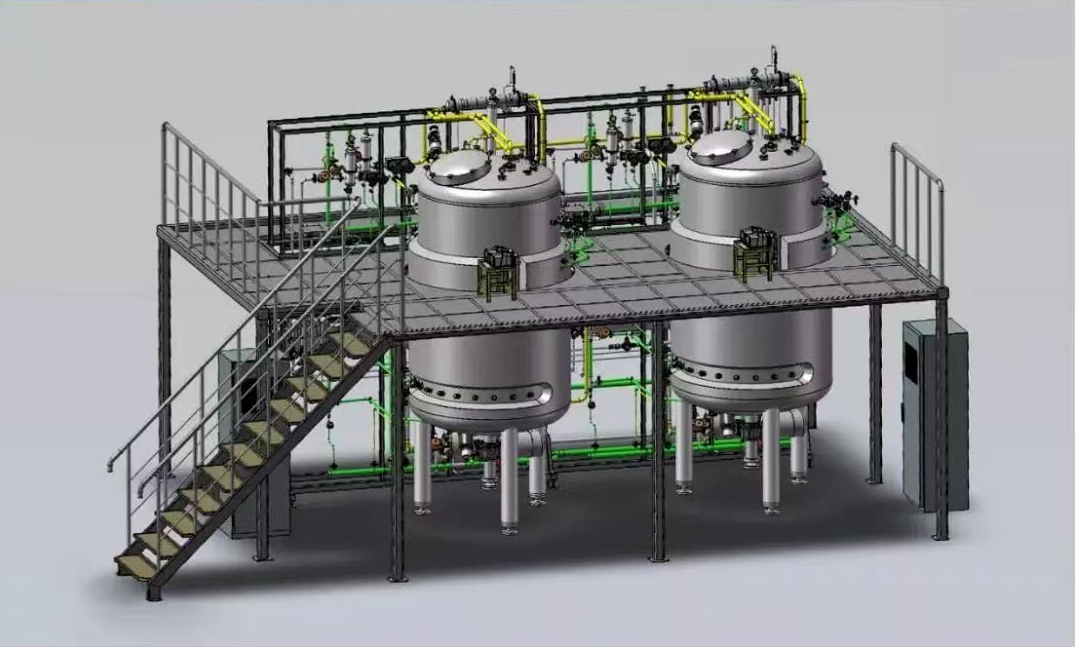
During the transition from laboratory-scale bench trials to industrial production in fermentation industries, fermenter scale-up is a pivotal factor determining production efficiency and product quality. The process must not only maintain consistent fermentation titer across different scales but also mitigate the impacts of variations in physical parameters and operating conditions. A rigorous scale-up logic is therefore required: first identify the core parameters governing fermentation performance to establish scale-up criteria, then migrate process conditions from lab and pilot scales to full-scale production equipment via rational strategies. Below is a detailed elaboration on the fundamental principles and applicable methodologies for fermenter scale-up.
1. Core Scale-Up Criteria for Fermenters
Fermenter scale-up involves not only the enlargement of working volume and geometric dimensions but also the adjustment of operating parameters and physical conditions.
Physical characteristics inevitably change with equipment scaling, which tends to cause fluctuations in fermentation titer. To achieve comparable fermentation performance across scales, well-defined scale-up criteria must be adopted. Such criteria refer to the key physical and operational parameters that remain constant or serve as the primary reference for scale-up design, as these factors exert dominant influences on fermentation yield, efficiency and substrate conversion rate.
Commonly adopted criteria include equivalent volumetric oxygen mass transfer coefficient (KLa), equivalent power input per unit volume (P/V), and equivalent tip shear force (nd).
The selection of dominant scale-up criteria depends on which parameter imposes the most significant impact on fermentation titer. Priorities vary by product: some microbial strains are highly sensitive to shear stress, while others have stringent oxygen supply requirements. Essentially, scale-up criteria selection is a trade-off process that balances oxygen transfer (KLa), mixing and shear effects (P/V, nd), as well as physiological demands of microbial cells. Modern industrial practices predominantly adopt a multi-parameter dynamic regulation strategy (including agitation, aeration and fed-batch control) to replicate the optimal cellular metabolic microenvironment observed in laboratory settings, enabling direct scale-up to production fermenters with volumes exceeding hundreds of cubic meters.
2. Major Scale-Up Methods for Fermenters
Current fermenter scale-up approaches are categorized into the following types:
2.1 Empirical Scale-Up Method
This method relies on practical operational experience accumulated from existing production facilities and remains the most widely applied approach for industrial scale-up.
It delivers high success rates for robust microbial strains with broad process windows that tolerate fluctuations in dissolved oxygen and shear stress, as well as fermentation processes involving mixed cultures or filamentous fungi. These complex biological processes are difficult to fully characterize by theoretical models, and their scale-up heavily depends on long-term process experience and consistent product quality control.
Pure empirical scale-up is gradually being phased out in modern fermentation industries. It is now primarily reserved for mature production processes with stable strains and low susceptibility to operational variations. In most scenarios, empirical experience is combined with scientific modeling and data analysis to achieve precise process tuning and optimization.
Empirical scale-up is further divided into two categories:
Geometric Similarity Method: The fermenter is scaled up proportionally in geometric dimensions first, followed by parameter adjustment based on a single scale-up criterion (equivalent KLa, P/V or nd). For Newtonian fluid systems limited solely by oxygen transfer, geometric similarity combined with constant KLa is the preferred solution.
Non-Geometric Similarity Method: Geometric proportionality is abandoned, and two or more scale-up criteria are applied simultaneously. This approach is mandatory when multiple constraints (e.g., constant KLa together with constant P/V) need to be satisfied. It is extensively used for shear-sensitive fermentation processes, such as cultivation of filamentous fungi.
2.2 Dimensional Analysis Method
Based on the similarity principle, dimensional analysis is a rigorous scientific scale-up technique. The core theory states that if two systems of different scales (laboratory and industrial fermenters) maintain identical key dimensionless numbers, their hydrodynamic, mass transfer and heat transfer behaviors will be analogous, enabling accurate prediction of performance at scaled-up volumes. Typical dimensionless parameters include aeration number (Na) and Reynolds number (Re). A dimensionless number is a unitless value derived from combinations of physical quantities such as characteristic length, flow velocity, fluid density and viscosity, representing the ratio between two interacting forces within a system.
A time constant is defined as the ratio of a variable to its rate of change, which characterizes the response rate or inherent kinetic rhythm of a physical or biological process. The major time constants involved in fermentation scale-up are listed below:
Reaction Time Constant (\(t_r\)): \(t_r = C/r\)
(C: substrate concentration; r: reaction rate). It represents the theoretical time required to consume the substrate at the current reaction rate and serves as the fundamental reference for process analysis. Any process with a far larger time constant than \(t_r\) is identified as the rate-limiting step.
Diffusion Time Constant (\(t_D\)): \(t_D = L^2/D_z\)
(L: characteristic length; \(D_z\): axial diffusion coefficient). It quantifies the time required for substance transport via molecular diffusion. Being proportional to the square of characteristic length, molecular diffusion deteriorates drastically with scale enlargement. This parameter is critical for high-viscosity systems and stagnant zones such as microbial flocs and membrane boundaries, where insufficient diffusion may lead to localized nutrient depletion.
Mixing Time Constant (\(t_m\)): \(t_m = T_m/n\)
(\(T_m\): dimensionless mixing time; n: agitation speed). It reflects the time needed to achieve homogeneous distribution inside the fermenter. A larger \(t_m\) indicates poor mixing efficiency. Scale-up typically leads to prolonged mixing time, resulting in gradients of concentration, temperature and pH, and heterogeneous cellular microenvironments — a major challenge for geometrically similar scale-up.
Residence Time Constant (\(\tau\)): \(\tau = L/u\)
(L: characteristic length; u: linear flow velocity). It denotes the duration that fluid elements reside in the reactor, equivalent to the mean residence time in continuous fermentation. Proper matching between flow rate and working volume is required to avoid flow short-circuiting and dead zones.
Mass Transfer Time Constant (\(t_{mt}\)): \(t_{mt} = 1/KLa\)
(KLa: volumetric oxygen mass transfer coefficient). It stands for the time required for oxygen to transfer from gas bubbles to the liquid phase, and is inversely correlated with oxygen supply capacity. Since KLa generally declines during scale-up, increased \(t_{mt}\) frequently makes oxygen transfer the bottleneck, hence maintaining constant KLa is one of the most prevalent scale-up criteria.
Heat Transfer Time Constant (\(t_h\)): \(t_h = L^2/c\)
(L: characteristic length; c: heat transfer coefficient). It describes the time scale for heat removal and is proportional to the square of characteristic length. Fermentation heat generation scales with reactor volume, while heat exchange area increases much more slowly during scale-up. Elevated \(t_h\) may cause heat accumulation and temperature runaway.
Process limitations can be identified by comparative analysis of different time constants, which guides targeted scale-up design:
If \(t_{mt} \gg t_r\): Oxygen supply cannot meet microbial consumption, and the process is oxygen-limited. Scale-up shall prioritize constant KLa.
If \(t_m \gg t_r\): Inadequate mixing generates inhomogeneous environments. Scale-up shall focus on improving mixing performance via constant P/V or equivalent mixing time.
If scaled-up \(t_h\) approaches \(t_r\): Heat removal capacity becomes insufficient with overheating risks. Heat exchange systems must be re-evaluated and upgraded.
If \(t_r\) is the dominant time constant: The process is restricted by intrinsic microbial metabolism, and optimization of physical environments plays a secondary role.
It should be noted that these time constants are not fixed values throughout fermentation, as variations in broth viscosity and cell concentration will alter \(t_m\) and \(t_{mt}\). Accurate determination of time constants relies on experimental data. This method provides strategic guidance, and is usually combined with dimensional analysis (for initial parameter setting), mathematical modeling and CFD simulation (for precise performance prediction) to complete scale-up design.
2.4 Mathematical Modeling Method
This approach establishes mathematical equations to describe fermentation processes based on fundamental principles and massive experimental data. Process simulation, design and scale-up are subsequently performed via computer calculation. With the advancement of information technology and big data analytics, data-driven scale-up has gained increasing application in the fermentation industry.
The core objective of fermenter scale-up is to balance variations in physical and operational parameters during capacity expansion, stabilize fermentation titer, and resolve typical challenges including deteriorated oxygen transfer, heat removal and mixing efficiency. Scale-up criteria focus on key parameters such as KLa, P/V and nd, with dynamic operation adjustment to replicate the optimal laboratory metabolic environment. The integrated scale-up system covers empirical approaches (geometric/non-geometric similarity), dimensional analysis (dimensionless numbers), time constant analysis (bottleneck identification) and mathematical modeling, spanning from traditional experience to digitalized design.
These theories and methodologies provide solid technical support for industrial fermenter design, reduce trial-and-error risks and production fluctuations caused by blind scale-up, and enable customized optimization of mass transfer, heat transfer and mixing systems for diverse fermentation products. Ultimately, they underpin the construction of efficient, stable and adaptable industrial fermentation production lines, guaranteeing consistent quality and high productivity for large-scale manufacturing.