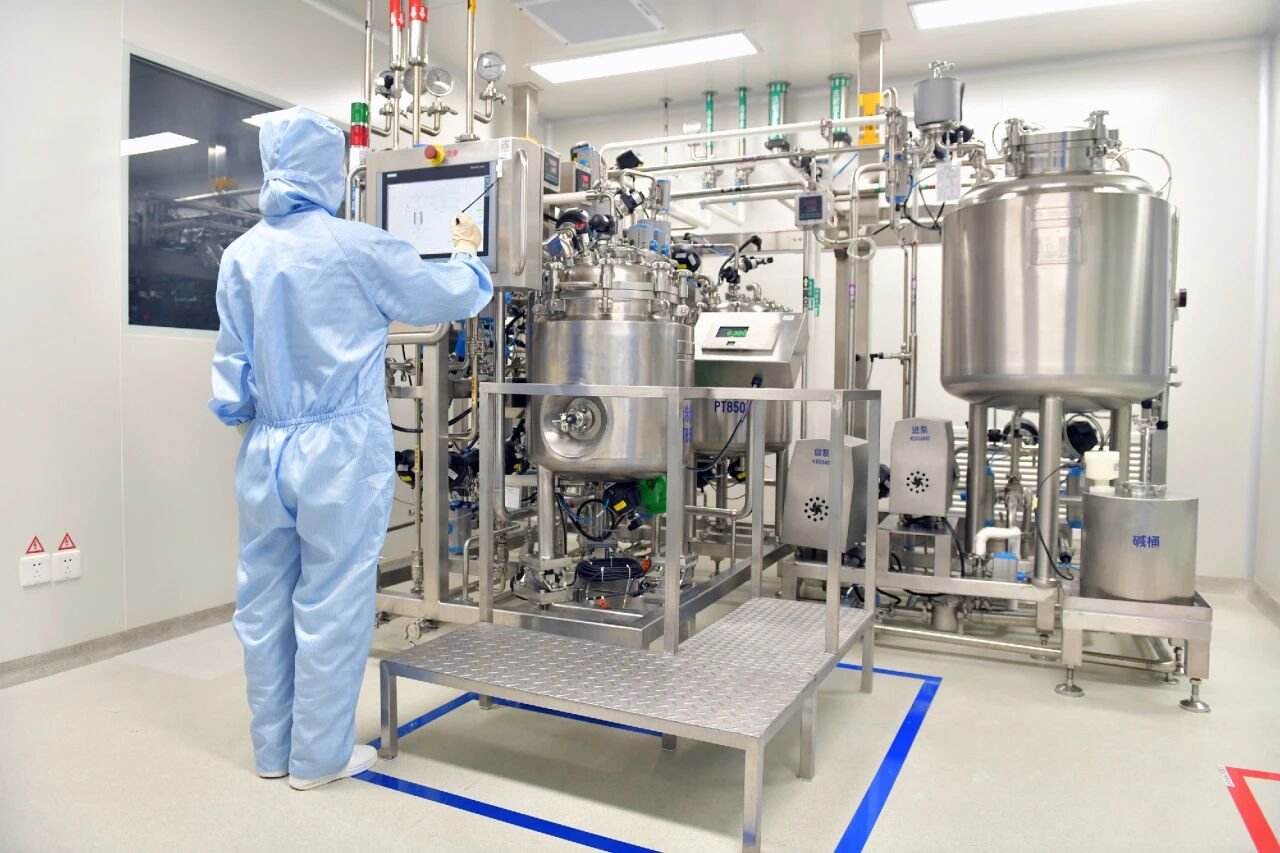
Microcarrier-based suspension culture has become the mainstream scalable production platform for mammalian cells in biomanufacturing, widely adopted for viral vector production, vaccine seed cultivation, antibody-expressing cell lines and cell therapy raw material preparation. With the push toward high-density perfusion cultivation to boost volumetric productivity and reduce bioreactor footprint, extremely high viable cell concentrations anchored on microcarriers bring a prominent technical bottleneck: localized carbon dioxide accumulation.
Excess dissolved CO₂ triggers severe hypercapnia within the microcarrier pellet clusters, lowers culture pH uncontrollably, impairs cell metabolism, suppresses cell proliferation viability and ultimately cuts target protein or viral product harvest yields significantly. Traditional top-mounted sparging and headspace ventilation designs struggle to eliminate trapped CO₂ inside dense microcarrier aggregates, making pH correction via alkali addition only a temporary palliative measure with secondary osmotic pressure risks. This article elaborates on the root hazards of CO₂ buildup in high-density microcarrier cultures and introduces targeted bottom-up gas stripping paired with optimized enrichment matrix algorithms as a reliable technical solution.
1. Mechanisms and Adverse Impacts of CO₂ Accumulation in Microcarrier Cultures
In low-cell-density batch culture, conventional surface aeration and dispersed sparging can timely strip metabolic CO₂ out of the bulk culture medium. Nevertheless, when cell density climbs to high levels supported by microcarriers, cells tightly adhere and stack to form compact three-dimensional microcarrier aggregates.
Mass transfer limitations emerge inside these dense clusters: CO₂ continuously excreted by anchored cells cannot rapidly diffuse outward to the bulk liquid phase, resulting in localized hypercapnia far exceeding the safe threshold. Dissolved CO₂ dissolves into the medium to form carbonic acid, causing sustained regional pH decline that cannot be fully offset by overall bioreactor pH feedback regulation.
The negative consequences are multi-layered:
Suppressed cell viability and prolonged lag phase, reduced maximum achievable cell density ceiling;
1.Altered intracellular glycolysis and energy metabolism pathways, leading to lower specific productivity of recombinant proteins or viruses;
2.Frequent, excessive base dosing elevates medium osmolality, further stressing fragile mammalian cells and worsening product quality consistency;
3.Batch-to-batch variability increases, raising downstream purification difficulty and overall production costs.
4.Standard bioreactor aeration tuning, including higher agitation speed and increased sparge gas flow, carries inherent drawbacks: excessive shear force detaches adherent cells from microcarriers or triggers cell apoptosis, which is unacceptable for microcarrier culture workflows.
2. Technical Solution: Bottom-Up Gas Stripping + Optimized Enrichment Matrix Algorithms
We propose a combined process solution integrating physical gas stripping and digital algorithmic control, fundamentally resolving trapped CO₂ accumulation without introducing damaging hydrodynamic shear.
2.1 Bottom-Up Targeted Gas Stripping Strategy
Different from traditional headspace and top sparging layouts, the gas distribution network is rearranged for bottom-up stripping operation. Sparging points are distributed close to the microcarrier suspension settling zone, enabling low-shear bubble flow to penetrate microcarrier clusters gently.
Stripping gas composition is precisely calibrated: low-concentration air or nitrogen is introduced to carry away accumulated dissolved CO₂ directly from the interior of cell-laden microcarrier pellets. Bubbles ascend gradually through the carrier bed, breaking stagnant liquid boundary layers around microcarriers and breaking down local CO₂ enrichment zones.
1.Low gas flow rate avoids cell detachment and shear damage;
2.Directional bottom-up flow eliminates dead volume where CO₂ tends to stagnate;
3.Real-time dissolved CO₂ (dCO₂) probes monitor local gradient changes for closed-loop aeration adjustment.
This localized stripping approach directly addresses the root mass transfer limitation inside microcarrier aggregates, rather than merely adjusting the overall bulk medium parameters.
2.2 Optimized Enrichment Matrix Algorithm for Intelligent Parameter Tuning
Even with improved gas stripping hardware, fixed aeration parameters fail to adapt to dynamically changing cell metabolic rates across different culture stages. We deploy a customized enrichment matrix algorithm to map the coupling relationship among cell density, microcarrier loading quantity, agitation rate, stripping gas flow rate, dCO₂ gradient and pH shift.
The algorithm establishes a multi-dimensional data matrix to:
1.Predict real-time regional CO₂ enrichment degree inside microcarrier clusters;
2.Automatically adjust bottom-up stripping gas proportion and flow without manual intervention;
3.Distinguish global bulk pH drift from localized hypercapnia-induced pH drop, avoiding over-dosing of neutralizing alkali;
4.Build predictive control models for perfusion feeding rate matching, synchronizing nutrient replenishment and metabolic waste stripping.
The algorithm runs on the bioreactor distributed control system (DCS), outputs continuous optimized setpoints, and achieves stable long-term high-density microcarrier culture with minimal manual operation intervention.
3. Practical Application Benefits
1.Eliminates localized hypercapnia reliably, stabilizes intra-cluster pH environment, restores normal cell proliferation kinetics;
2.Abandons over-reliance on alkali neutralization, keeps medium osmolality within optimal range, improves cell-specific productivity;
3.No increase in agitation intensity or large bubble sparging, effectively prevents cell detachment from microcarriers and shear-induced cell death;
4.Algorithm-driven automatic parameter optimization reduces operator experience dependence, delivers stable batch consistency and repeatability for GMP-compliant commercial manufacturing;
5.Supports further elevation of microcarrier loading density and extended perfusion culture cycles, amplifying single bioreactor volumetric output and cutting unit production costs.
Localized CO₂ accumulation and hypercapnia are key bottlenecks restricting productivity uplift in high-density microcarrier mammalian cell culture. Conventional global aeration and pH adjustment methods only mitigate symptoms instead of solving the fundamental mass transfer defect within microcarrier aggregates.
The integrated scheme of bottom-up directional gas stripping plus optimized enrichment matrix algorithms directly targets trapped CO₂ enrichment zones inside carrier pellets. It stabilizes the microenvironment for adherent cells, lifts product yield ceiling, ensures culture process robustness, and provides a scalable, GMP-adaptable process upgrade route for large-scale vaccine, antibody and cell therapy raw material manufacturing based on microcarrier bioreactors.