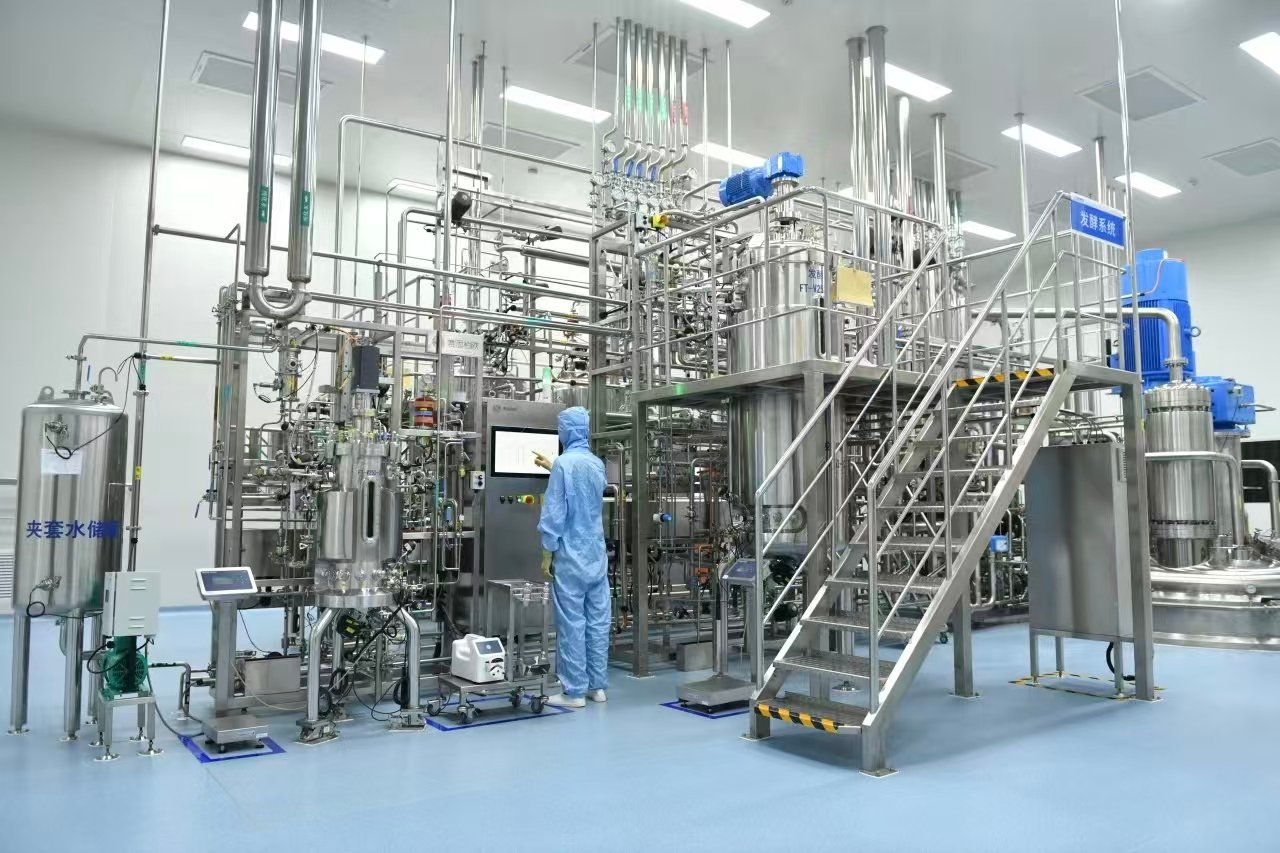
In industrial fermentation, dissolved oxygen (DO) is a critical process parameter, especially for aerobic fermentation. The DO level directly governs microbial growth, metabolism and target metabolite biosynthesis. For the production of antibiotics, amino acids, enzymes and polysaccharides, precise DO control often determines the success or failure of fermentation batches.
Impacts of Dissolved Oxygen on Fermentation
The effects of DO are most pronounced in aerobic fermentation systems. During submerged cultivation, aerobic microorganisms require sufficient dissolved oxygen to sustain respiratory metabolism and the synthesis of specific metabolites. Microbes can only utilize molecular oxygen dissolved in liquid media; oxygen exhibits extremely low solubility in water. At 25 °C and 0.1 MPa, the solubility of atmospheric oxygen in fermentation broth is merely 0.22 mmol/L. In contrast, microbial oxygen uptake rates range from 25 to 100 mmol/(L·h). Without continuous oxygen supply, saturated dissolved oxygen can only support normal microbial metabolism for 15 to 50 seconds.
Different microbial strains possess distinct oxygen demands, defined by the critical oxygen concentration—the minimum DO concentration that does not inhibit microbial respiration or product formation. This value generally falls between 0.003 and 0.05 mmol/L, equivalent to 1%–25% air saturation. For reference, bacteria and yeasts have a critical oxygen threshold of 3%–10% saturation, actinomycetes 5%–30%, and filamentous fungi 10%–15%. In industrial practice, DO concentration regulates not only biomass accumulation but also metabolic flux and product titer.
Take L-glutamic acid fermentation as an example: insufficient oxygen supply drastically reduces glutamic acid yield while triggering massive by-product formation of lactic and succinic acids. For vitamin B12 fermentation, oxygen supply is restricted in the early stage to accumulate factor B precursors, followed by enhanced aeration to complete the bioconversion, demonstrating the staged requirement of DO regulation.
Notably, excessively high DO concentrations are not beneficial. Elevated DO may suppress the biosynthesis of certain metabolites and induce oxidative damage to microbial cells. Therefore, strain-specific optimal DO setpoints must be established through experimental trials and process experience for targeted, precise real-time control throughout fermentation.
Oxygen Supply-Demand Balance in Fermentation Broth
The instantaneous DO concentration in fermentation broth is governed by the dynamic equilibrium between oxygen supply and oxygen consumption. Oxygen supply describes the mass transfer of oxygen from the gaseous phase to the liquid phase, encompassing bubble generation, dissolution and molecular diffusion. Oxygen consumption refers to the uptake of dissolved oxygen by microorganisms for respiratory metabolism.
Sterile compressed air is introduced into bioreactors, and mechanical agitation disperses air into microbubbles to expand gas-liquid interfacial area and extend oxygen mass transfer residence time. The oxygen transfer rate is defined by the formula:
\(OTR = K_L a (c^* – c_L)\)
where \(K_L a\) = volumetric mass transfer coefficient, \(c^*\) = saturated dissolved oxygen concentration, \(c_L\) = actual bulk liquid DO concentration. Boosting either \(K_L a\) or \(c^*\) improves oxygen supply capacity.
Microbial oxygen uptake rate is modulated by biomass concentration, culture age, substrate type and concentration, temperature, pH and other environmental variables. Oxygen consumption follows a predictable profile during fermentation:
1.Early exponential phase: Rapid biomass proliferation drives a sharp rise in oxygen uptake, creating a DO valley;
2.Product formation phase: Metabolic activity stabilizes, leading to steady oxygen consumption;
3.Late fermentation phase: Cell senescence reduces respiratory activity, and DO levels rebound.
Abnormal DO profiles serve as critical diagnostic signals for process deviations. Persistently low DO typically indicates contamination by aerobic heterotrophic microbes or aeration/agitation equipment malfunction. Unusually elevated DO often signals impaired cellular metabolism or phage infection. Continuous DO curve monitoring enables timely identification of process abnormalities and rapid process adjustments.
Dissolved Oxygen Control Strategies for Fermentation Broth
DO regulation is implemented by manipulating oxygen supply and modulating microbial oxygen consumption separately.
1. Oxygen Supply Modulation
(1) Adjust aeration rate and agitation speed
Volumetric airflow and stirring speed are the primary operational variables governing DO. Increasing aeration expands gas-liquid contact area and elevates the oxygen concentration driving force. Higher agitation speed reduces bubble diameter, enhances liquid turbulence and lowers mass transfer resistance, thereby increasing \(K_L a\). In large-scale bioreactors, airflow is regulated via inlet and exhaust valve throttling, while stirrer speed is controlled by variable-frequency drives. Coordinated tuning of aeration and agitation is required to avoid mechanical overload and compromised mixing efficiency.
(2) Elevate oxygen partial pressure via gas composition modification
Enriching inlet air with pure oxygen or oxygen-enriched air raises \(c^*\) to strengthen oxygen supply. Despite higher operational costs, this approach delivers outstanding performance for high oxygen-demand fermentations such as xanthan gum production.
(3) Adjust bioreactor headspace pressure
Elevating tank pressure increases oxygen partial pressure and corresponding \(c^*\). However, pressure elevation is constrained by equipment design limits; excessive pressure raises power consumption and elevates dissolved CO₂ concentration, which may disrupt microbial metabolism.
(4) Modulate physicochemical properties of fermentation broth
Broth viscosity and surface tension evolve throughout fermentation, altering bubble morphology and oxygen mass transfer efficiency. Optimized basal medium formulation and fed-batch feeding strategies indirectly improve oxygen transfer performance.
2. Oxygen Consumption Regulation
Oxygen uptake rate is primarily modulated by controlling biomass concentration:
1.Optimize basal medium formulation to avoid over-dense or insufficient cell populations;
2.Regulate microbial growth rate via intermediate fed-batch feeding (glucose, phosphate and other nutrients);
3.Implement feedback fed-batch control triggered by DO or tail gas CO₂ signals to maintain cells under semi-starved conditions, balancing biomass growth and target product biosynthesis.
Modern automated fermentation platforms integrate DO with pH and feeding rate for cascade control. For penicillin fermentation, for instance, the glucose feed rate automatically rises when DO exceeds the setpoint to boost oxygen consumption; conversely, feeding is reduced to restore DO to the target range when DO drops below specification.
Dissolved Oxygen Measurement
1. Dissolved Oxygen Electrodes
In-line DO measurement for bioreactors relies on oxygen sensors, categorized into three mainstream types: polarographic, galvanic and optical DO electrodes.
Polarographic electrodes: Require an applied polarization voltage of 0.6–0.8 V. Electrochemical reactions occur between a platinum cathode and Ag/AgCl anode: dissolved oxygen is reduced to hydroxide ions at the cathode, generating an electric current proportional to oxygen partial pressure. A polytetrafluoroethylene gas-permeable membrane covers the sensor tip, permitting oxygen molecule permeation while blocking liquid and ionic species. Polarographic electrodes feature fast response, stable readings and minimal airflow interference, making them the standard sensor for industrial bioreactors.
Galvanic electrodes: Generate electric current via inherent electrochemical potential differences without external polarization. The structure is simple, yet they consume oxygen during measurement and are highly susceptible to bubble interference, limiting their current industrial application.
Optical DO electrodes: Next-generation sensors operating on the fluorescence quenching principle, requiring no polarization voltage or electrolyte. Characterized by low maintenance and rapid response, they are undergoing widespread industry adoption.
DO electrodes require two-point calibration prior to deployment: zero calibration in an oxygen-free environment and saturation calibration in air-saturated liquid set to 100%. Sensor readings represent the percentage of air saturation under process conditions. Temperature, pressure and agitation introduce measurement bias and must be compensated where necessary.
2. Measurement Principle of Optical Dissolved Oxygen Electrodes
The core mechanism of optical DO sensors is fluorescence quenching, outlined in four sequential steps:
Excitation: The sensor tip is coated with specialized fluorescent dye. A blue excitation light of specific wavelength irradiates the dye, absorbing photon energy and transitioning dye molecules to an unstable excited state.
Emission and Quenching: Excited dye molecules spontaneously return to the ground state, releasing stored energy via red fluorescence emission.
Core mechanism: Dissolved oxygen molecules collide with excited-state fluorophores. Energy transfers from dye molecules to oxygen rather than being emitted as light—a phenomenon defined as fluorescence quenching. Higher oxygen concentration increases collision frequency and amplifies quenching effects.
Signal Detection: The sensor quantifies fluorescence lifetime or phase shift instead of absolute fluorescence intensity. Oxygen-induced quenching shortens fluorescence lifetime:
1.Higher DO = stronger quenching = shorter fluorescence lifetime
2.Lower DO = weaker quenching = longer fluorescence lifetim
Signal Conversion: The on-board detector precisely measures fluorescence lifetime or phase deviation and converts signals to accurate DO concentrations via pre-established calibration curves.
3. Maintenance Protocols for Optical Dissolved Oxygen Electrodes
Low maintenance demand constitutes the primary advantage of optical DO sensors.
Routine Daily Maintenance
Clean the sensor cap with a soft damp cloth and non-abrasive detergent to remove surface biomass and broth residues. Harsh chemicals that scratch or degrade the fluorescent coating (strong acids, strong alkalis, polar organic solvents including acetone and toluene) are strictly prohibited. Inspect the fluorescent sensor cap for physical scratches and damage. Minor surface abrasions exert negligible impact on readings, while severe damage mandates cap replacement.
Periodic Preventive Maintenance
The fluorescent sensor cap is a consumable component; fluorophores undergo gradual photodegradation even under idle storage, with a typical service life of 1–2 years (per manufacturer specifications). Replace the cap when persistent signal drift, sluggish response or failed calibration occurs. Replacement is straightforward—old caps are unscrewed and new units installed without electrolyte refilling.
Optical electrodes eliminate polarization requirements and simplify calibration workflows. Two-point calibration is optional due to exceptional zero-point stability; single-point saturation calibration (calibrated to 100% in ambient air or air-saturated water) suffices for routine use. Most optical sensors are pre-calibrated at the factory, requiring only single-point validation on-site before operation.
Thoroughly clean and fully dry the fluorescent cap prior to storage. Avoid prolonged exposure to intense light (especially ultraviolet radiation), which accelerates fluorophore degradation. Sensors are stored dry at ambient temperature with no immersion required.






