

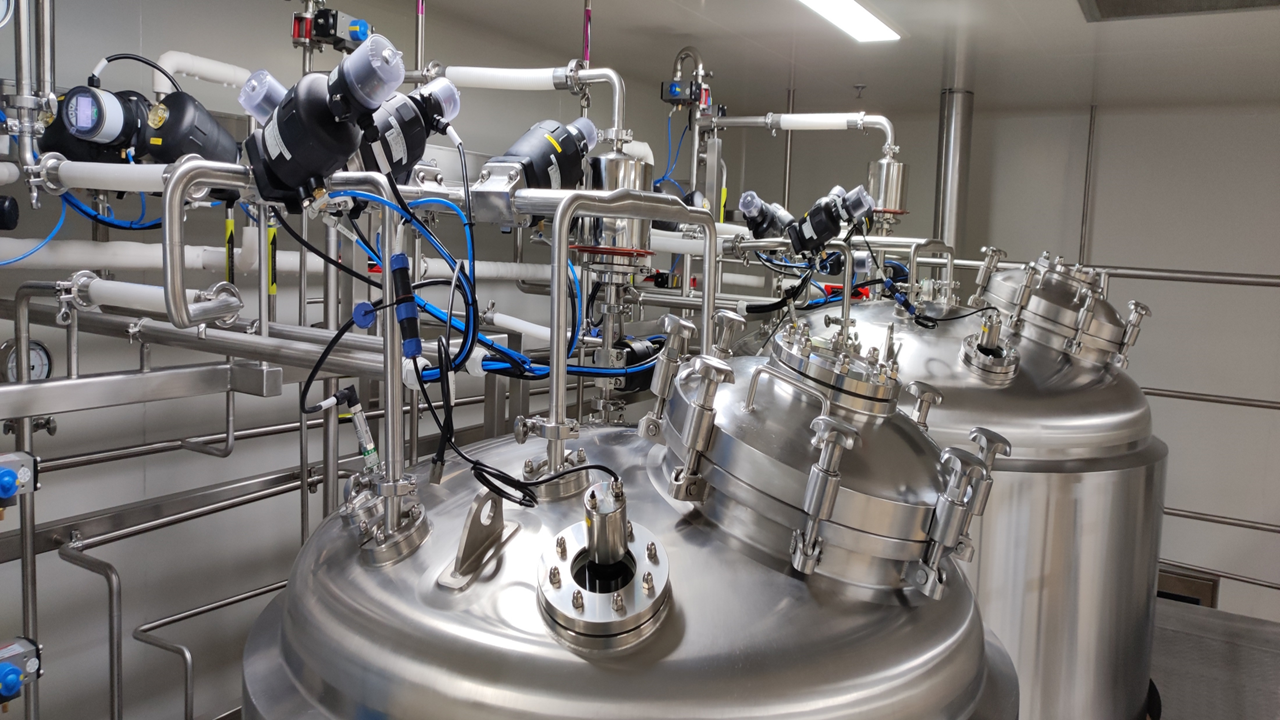
During process scale-up, scale-independent variables including temperature, pH, dissolved oxygen setpoint and feeding strategy can be readily maintained stably. Nevertheless, scale-relevant parameters such as agitation, impeller tip speed, mixing time, Reynolds number and aeration flow rate cannot be kept constant simultaneously. This stems from their varying dependencies on agitation speed, impeller diameter and vessel diameter. These parameters ultimately affect operational costs, cultivation heterogeneity, gas transfer characteristics and shear stress exerted on cells. Essentially, bioreactor scale-up involves comprehensive trade-offs and compromises.
The volumetric power input of stirred-tank bioreactors generally ranges from 10 to 80 W/m³, while other indicators including mixing intensity, mixing time, impeller tip speed and Reynolds number vary across production scales. Agitation speed declines as working volume increases. Conversely, impeller tip speed and Reynolds number rise owing to enlarged impeller dimensions. Mixing time also extends with growing vessel diameter.
Geometric Similarity
Geometric similarity serves as the primary criterion for bioreactor scale-up. When tank diameter expands, all linear dimensions including tank height, impeller diameter and impeller width increase proportionally. For cell culture bioreactors, the height-to-diameter ratio (H/D) is 1–2 for bench-scale units and 2–3 for pilot and commercial-scale vessels. Maintaining a fixed H/D ratio imposes impacts on surface and volume-related properties such as heat transfer, gas transfer and mixing efficiency. Heat exchange occurs at the tank wall, hence volumetric heat transfer capacity diminishes with volume expansion. A constant H/D ratio also markedly reduces the surface area-to-volume ratio (Ac/V), weakening surface aeration-mediated oxygen supply and carbon dioxide stripping. Given the critical role of gas transfer and constraints on mixing intensity and aeration rate, this factor carries great significance for shear-sensitive cell lines.
Dynamic Similarity and Scale-Up Criteria
Dynamic similarity is achieved when ratios of all relevant forces remain consistent across scales, generating analogous flow field distribution. Scale-up criteria are selected based on dominant factors governing cell culture performance. Due to mutual parameter interdependency, stabilization of one key indicator may trigger drastic variations of other parameters with volume enlargement, potentially inducing unprecedented technical issues at large scales.
For instance, constant volumetric power input during scale-up leads to elevated maximum shear stress attributed to higher tip speed and reduced agitation speed. Lower agitation further prolongs mixing time and raises risks of heterogeneous cultivation microenvironments. Constant impeller tip speed or Reynolds number, which sustains identical hydrodynamic conditions, also results in weakened mixing efficiency.
Constant impeller tip speed is applicable to cultivation of shear-sensitive cells. Reduced volumetric power input needs compensation via enhanced aeration to retain acceptable oxygen transfer rate, yet excessive aeration may incur cell damage. Meanwhile, lowered mixing intensity associated with fixed tip speed causes insufficient homogenization in large-scale bioreactors. Accordingly, this criterion is unsuitable for scale conversion with substantial volume gaps. Maintaining identical mixing time elevates impeller tip speed, posing threats to cell viability and triggering sharp growth of power consumption. Oxygen transfer efficiency, mixing performance and adequate CO₂ stripping are acknowledged as core considerations in bioreactor scale-up. Consequently, criteria minimizing adverse impacts on gas transfer and mixing are predominantly adopted for CHO cell culture scale-up.
Common Scale-Up Strategies for CHO Cell Culture
This section elaborates mainstream scale-up strategies for CHO cell cultivation in bioreactors and analyzes their practical implications. Recent studies on cell culture performance across different scales and corresponding scale-up principles are also outlined.
Constant Volumetric Power Input
Constant power input per liquid volume (P/V) ranks among the most prevalent scale-up criteria for stirred aerated bioreactors. Mechanical power delivered by impellers regulates gas transfer behaviors and culture homogenization. The P/V ratio can be adjusted by modifying impeller configuration, size and rotational speed to adapt to variable working volumes. As illustrated in Table 7, this criterion can be applied independently or combined with other parameters such as constant volumetric gas flow rate per liquid volume (vvm).
Successful process transfer from Ambr® 250 micro bioreactor system to 200 L single-use pilot bioreactor has been accomplished with fixed P/V, verifying the feasibility of air sparging-based pH control strategy. Comparable cell growth, productivity and product quality profiles are obtained between 500 L pilot scale and 3 L bench scale, as well as in sequential scale-up from Ambr® 250 to 3 L and further to 50 L bioreactors. Constant P/V also functions as a reliable scale-down benchmark to replicate cultivation conditions and performance of 18,000 L industrial bioreactors in Ambr® 250 systems. Consistent culture outcomes are observed between 200 L and 2,000 L scales, albeit higher partial pressure of carbon dioxide (pCO₂) detected in larger vessels.
Nevertheless, fixed P/V may cause notable discrepancy in volumetric oxygen mass transfer coefficient (kLa) between small and large scales. Aeration parameters require fine tuning to stabilize dissolved oxygen concentration, especially in upstream process development utilizing micro bioreactors. Improper flow rate adjustment may impair cultivation performance. Research indicates that exclusive adoption of P/V criterion for scale-down from 2,000 L industrial bioreactor to 3 L laboratory unit leads to declined viable cell density and final product titer. The normalized gas flow rate in small-scale bioreactors triples that in large vessels, aggravating bubble-induced cell damage.
Transcriptomic analysis was conducted to evaluate gene expression variations during scale conversion from Ambr®15 micro bioreactor to 10 L bioreactor under constant impeller tip speed and constant P/V criteria. Equivalent cell growth and specific productivity were achieved with both strategies. Lower pCO₂ levels were monitored throughout cultivation in Ambr®15, attributed to intensified CO₂ stripping driven by higher oxygen supply demand in microscale systems. Transcriptome comparison revealed less than 6% overall gene expression divergence between scales. Distinctly regulated genes were identified in Ambr®15 and 10 L bioreactors, yet no functional correlation was established between genetic alteration and scale-dependent cellular behaviors.
Constant Volumetric Oxygen Mass Transfer Coefficient (kLa)
Sustaining efficient oxygen transfer is indispensable for high-density CHO cell cultivation, making constant kLa a widely adopted scale-up and scale-down strategy. Ambr®250 has been validated as an effective scale-down model for 5 L laboratory and 250 L single-use bioreactor (SUB) systems under fixed kLa. A kLa value of 2–3 h⁻¹ satisfies oxygen metabolic demands, yielding comparable growth kinetics, productivity and final product concentration in 11 out of 13 GS-CHO and DG44-CHO cell lines. Adjustment of agitation and aeration parameters to maintain kLa at 7.9 h⁻¹ generates consistent growth curves across 50 L to 2,000 L single-use bioreactors.
Scale conversion often necessitates sparger type replacement, complicating replication of identical process conditions. Perforated spargers applied in 2,000 L bioreactors cannot be directly replicated in 3 L scale-down units; porous spargers are deployed instead to avoid excessive mixing intensity and aeration flow rate that deteriorate cell growth. Alteration of sparger configuration inevitably induces divergent cell proliferation and metabolic patterns compared with large-scale processes.
A mathematic mass transfer model was established to characterize gas exchange dynamics inside bioreactors. Mass balance equations incorporating cellular oxygen and carbon dioxide consumption rates (qO₂, qCO₂) and mass transfer coefficients (kLaO₂, kLaCO₂) are applied to calculate optimal aeration flow rate for oxygen sufficiency and pCO₂ prediction. This scale-up approach achieves equivalent viable cell density and antibody production in 2 L and 1,500 L bioreactors. Similarly, oxygen consumption data acquired from 2,000 L production bioreactors serves as reference to determine targeted kLa and oxygen enrichment level in 3 L scale-down models, supporting stable cultivation performance and intact protein quality.
Constant Volumetric Gas Flow Rate per Liquid Volume (vvm)
Accumulation of dissolved carbon dioxide poses a major challenge in CHO cell culture scale-up. Constant vvm is commonly implemented to facilitate sufficient CO₂ stripping, accompanied by agitation speed regulation to guarantee adequate oxygenation. Ambr®15 micro bioreactor is utilized to establish scale-down models for industrial and bench-scale facilities, with total sparging gas flow rate set as the core scaling parameter at vvm of 0.01–0.02. This approach ensures uniform gas stripping efficiency and consistent CO₂ emission profiles across scales. Optimal operational parameters including cultivation temperature and pH determined via design of experiment (DoE) remain consistent between Ambr®15 and 5 L bioreactors.
Ambr®250 platform was employed to develop representative scale-down models for 500 L and 2,000 L single-use bioreactors using fixed vvm criteria. Surface gas transfer dominates CO₂ removal in small-scale systems, hence lower normalized aeration intensity is required to align pCO₂ variation trends among different scales. In processes sensitive to dissolved carbon dioxide fluctuation, constant vvm effectively harmonizes dissolved gas distribution between industrial production lines and Ambr®250 systems, resulting in matched viable cell density and product yield.
Combined criteria of minimum aeration vvm and equivalent P/V successfully synchronize cell proliferation, gas transfer efficiency and monoclonal antibody productivity across 3 L, 500 L and 2,000 L single-use bioreactors. Minimum air flow rate is predefined to secure adequate CO₂ stripping. In contrast, simultaneous application of constant P/V and vvm in Ambr®250 scale-down modeling leads to dissolved oxygen level below 5%, failing to recapitulate large-scale cultivation characteristics. Short gas residence time and reduced oxygen transfer capacity in microscale bioreactors account for this discrepancy.
Gas inlet velocity is another critical factor in scale-up practice, especially for large industrial bioreactors requiring high aeration volume for oxygen supplementation and CO₂ elimination. Inlet velocity exceeding 60 m/s triggers dramatic turbulence energy surge in sparging zones and impairs cell viability. Elevated gas injection also induces oxidative stress and accelerated amino acid consumption to restore intracellular redox balance. Velocity controlled below 20 m/s, or up to 50 m/s in partial cases, causes negligible cellular damage in bioreactors of all scales.
Constant Impeller Tip Speed
Equivalent impeller tip speed is adopted as a scale-up criterion to stabilize maximum shear stress level throughout volume conversion. Cultivation conducted at tip speed ranging from 0.7 to 0.8 m/s achieves analogous viable cell density and final product titer between Ambr® systems and bench-scale bioreactors. Tip speed exceeding 1.5 m/s is confirmed to cause irreversible cell damage.
Scale-up from Ambr®15 to 2 L bioreactor under fixed tip speed maintains stable cell growth and productivity, yet dissolved oxygen concentration declines in larger vessels. Significant volume expansion accompanied by constant tip speed results in insufficient oxygen transfer and poor homogenization, due to substantial decline of volumetric power input.
As a leading process-oriented engineering company, Sino Bioengineering delivers professional bioengineering solutions and comprehensive technical services to clients worldwide.
For more products and solutions: https://sinobioengg.com/category/solution/
For more service: https://sinobioengg.com/category/service/