

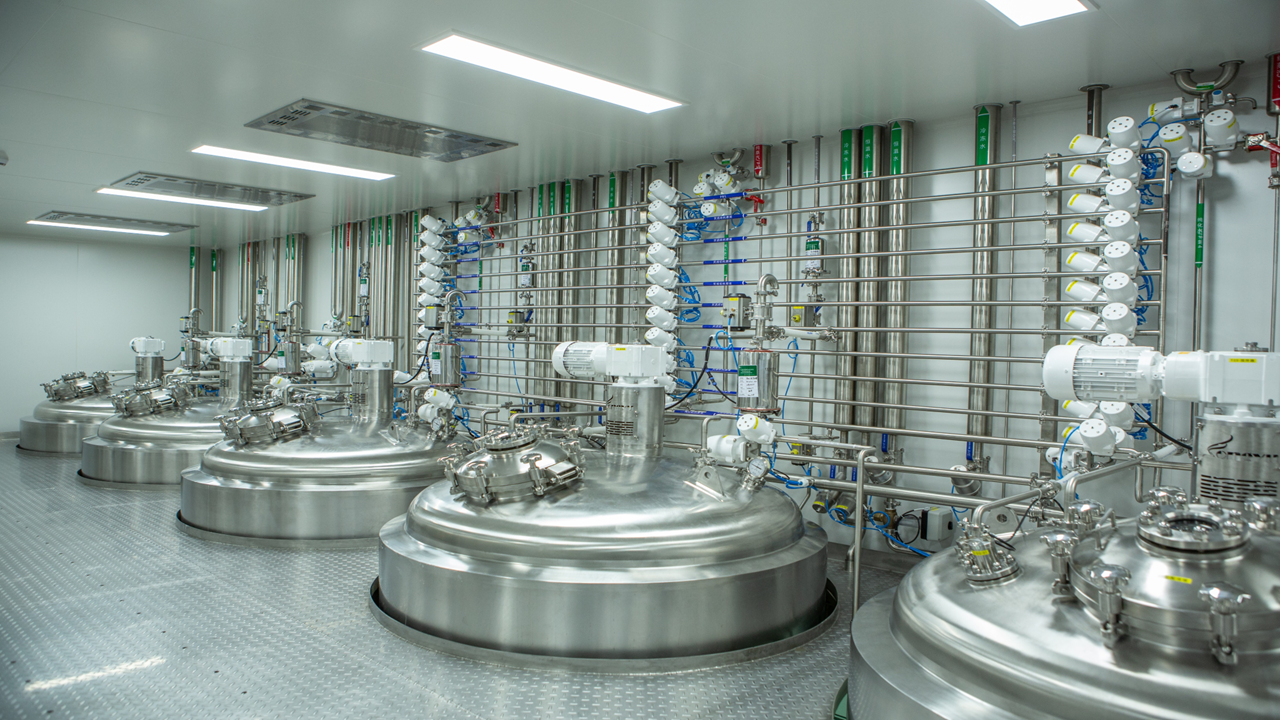
The HVAC system is fundamental to achieving the control of the environmental conditions within the biopharmaceutical facility. This is to provide workers with a comfortable working environment as well as the provision of rooms and the manufacturing
process with the necessary level of cleanliness and pressurisation to facilitate cGMP and BSL requirements for manufacturing. HVAC systems perform four basic functions:
1. Maintain room cleanliness. Control of airborne particles, dust, and micro-organisms is performed through air filtration using high-efficiency particulate air (HEPA) filters.
2. Maintain room pressure (ΔP). Areas that must remain “cleaner” than surrounding areas must be kept under positive pressurization, meaning that air flow must be from the cleaner area toward the adjoining space (through doors or other openings) to reduce the chance of airborne contamination. This is achieved by the HVAC system providing more air into the cleaner space than is mechanically removed from that same space.
3. Maintain space moisture (relative humidity). Humidity is controlled by cooling air to dew point temperatures or by using desiccant humidifiers. Humidity can affect the efficacy and stability of drugs and is sometimes important to effectively mold the tablets. Controlling the moisture content of the environment is also important in minimizing the potential for microbiological growth on clean room surfaces.
4. Maintain space temperature. Temperature can affect production directly by impacting chemical or biochemical reactions or indirectly by fostering growth of microbial contaminants in the process or on workers.
General System Overview
HVAC systems are driven by air handling units (AHUs). Conventional air handling units consist of filters, coils, and fans in a metal casing with an insulation liner applied to the inside of the casing.
Incoming air from outside the building enters the AHU and undergoes filtration through a series of roughing filters. Atmospheric air may contain a mixture of dry particles, fibres, smoke, fumes, and live/dead organisms. The airborne particle size varies from 0.01μm to 100μm and their concentration increases strongly closer to the ground. Therefore, AHU units should be placed on rooftops or in enclosures. Roughing filters are designed to capture a significant percentage of the total mass of these particles (30%) down to 20μm. These can easily be cleaned through washing. The newly filtered incoming air will then be cooled, and in that way, dehumidified. Cooling usually takes place via a cooling coil supplied by either chilled water or glycol supply from the facility central utility system. The cooled air may then be filtered again before being humidified again to meet the room air requirements. Humidification is achieved through steam injection with steam made up from purified water or WFI (see Section 45.7.4). Particularly for supply to clean rooms, there is a trend in using clean steam for humidification to maintain cleanliness levels. In times of low relative humidity, more humidification is needed than in times of high relative humidity.
Following humidification, the air is then heated up to the temperature required for room supply. Heating is achieved through a heating coil that could be supplied by the facility hot water system. The heated air is then discharged from the AHU via a supply fan into the HVAC duct network, which is responsible for distributing air to the rooms that are to be supplied from that dedicated AHU.
Air supply is then directed toward either a constant volume damper (CVD) or variable air volume (VAV) box. In the case of the use of a CVD, the volume of air supplied by the AHU is directed toward a re-heater, allowing for compensation of any temperature variations from the AHU. Temperature and air flow are determined by the specific room requirements and driven from the AHU centrally.
If a variable air volume system is used, the VAV box manipulates both temperature and air volume. If the incoming temperature of the air supplied from the AHU is too high compared with the set point value of the room, the VAV box will first reduce the reheating and increase the air volume. If the temperature is too low, then the air volume is reduced to a minimum and reheating will begin. The variable air volume system can be a more efficient approach because temperature and air volume are more closely attuned to the point of use. However, this should be evaluated against the number of rooms being supplied by an AHU because pressure balancing of rooms could be more of an issue due to the fact that air change variations are more frequent than via a constant volume approach.
Air at the correct temperature and volume is passed through a terminal high-efficiency particulate air (HEPA) filter before being dispersed into the room via a diffuser. Air exits the room via a wall louver, typically located near the floor and recirculated back via return fans to the AHU. Depending on the approach undertaken (single-pass or recirculation), returned air is expelled to the atmosphere or recycled. The quantity of expelled air can either be 100% in a once-through system, or only a certain percentage (typically 20%–30%) for a recirculation system, with fresh air being used to make up the volume lost.
Room Cleanliness
Although the HVAC system is responsible for the supply and control of the environment for the whole building, there is an emphasis on its design for supply and control of the manufacturing room environments, and particularly the clean rooms. Control and maintenance of room or space cleanliness and environment is an essential principle of cGMP.
Air filtration systems serving the product manufacturing process are designed to enable the control of particulate contamination. All air handling systems incorporate some type of air filtration scheme, whether built into the air handling unit, or using terminally installed high-efficiency particulate air (HEPA) filters. Filters are rated for their effectiveness in removing particulates of a nominal diameter of 0.3μm. The higher the efficiency rating,as a percentage, the more effective the filter is in preventing particulate contamination. Biopharmaceutical facilities commonly use HEPA filters with a minimal rating of 99.997% for critical operating areas.
Most HVAC systems operate on the principle of dilution to control the particulate count within a certain space. This is achieved through manipulation of the air exchange rate within a space. Even though various design guidelines and standards are available, there is no clear-cut guidance for air changes per hour. However, there is a common understanding in the pharmaceutical industry, and a regulatory requirement for a minimum air change rate for an area—typically a rate of 20 per hour for classified areas is chosen. This value typically increases with the room classification level: 20–40 air changes (AC)/h for Grade C and 40–60AC/h for Grade B areas are typical benchmarks. There is no minimum air change rate for non-classified areas, except as defined in local Building Codes (often 4 or 6 per hour), although the WHO guidance for OSD HVAC suggests that a room class, air change rate, and recovery period be established by the facility owner. The European GMP regulations have a requirement for a “clean up” time of 15 to 20 minutes in a sterile product processing facility. It is the resultant particulate level achieved in the various operating states (at-rest and dynamic) that is important and is the determining factor for specifying the air change rate.
In the cases where open processes may be undertaken within a room, certain particle extraction systems or containment systems may be employed and connected to the main facility HVAC. These could include but are not limited to:
Down Flow Booths
Recirculating air down flow booths provide a protection for the operator and environment when the open product will be handled. The down flow air, produced within the booth’s safe work zone area, forces clean air over the operator’s head and shoulders and downward toward the exhaust system at the bottom.
Local Laminar Flow system
In some areas, Cleanliness Class “A” is required. This class can be maintained by recirculating LF-Units only. Types and technical parameters depend on the dedicated application.
Laboratory Exhaust
Within laboratory areas, fume hoods and spot hoods are installed, providing safe working conditions for the personnel handling chemical substances. This equipment must be exhausted separately from that of the room exhaust.
The AHUs should be located on a separate equipment floor or zone to facilitate service and maintenance without disturbance to the aseptic/sterile manufacturing environment. Also, the location of outdoor air-inlet louvers must be carefully considered. Intakes should be located on the building sidewall high off the ground to minimize dust intake. Intakes should be away from truck docks or parking lots where undesirable fumes and particulates are generated. Location should also consider the prevailing winds and any nearby exhausts or fume concentrations to prevent recirculation of exhaust air back into the supply system.
Similarly, the location of the exhaust fans will require some consideration. Building exhausts are generally collected and ducted to exhaust fans in groups or clusters. Exhaust fans should be located as near to the building discharge as possible because this keeps the duct under a negative pressure and any leaks will be into the duct and not contaminated air from the duct into an occupied space or mechanical room. For this reason, roof locations of fans are preferred, even though this may make service difficult in severe weather conditions. When fans are located in mechanical rooms or interstitial spaces it is essential to tightly seal the discharge duct before it exits the building in a roof vent or wall louver. Roof penetrations should be kept to a minimum to prevent leaks. Fumes or toxic and hazardous exhausts should be extended through the roof and terminated well above the roof line in a suitable stack head. Dangerous biological agents may require HEPA filtration or other treatment, such as incineration, before expelling exhaust to the atmosphere.