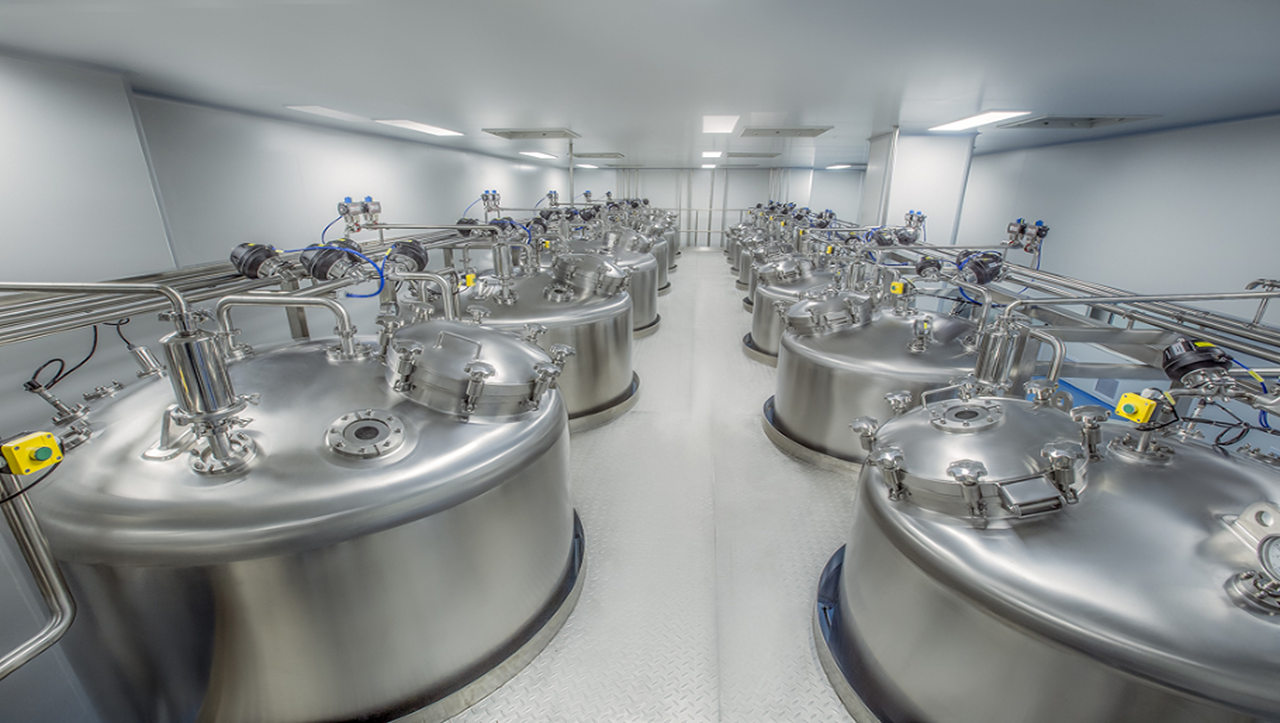
Within the biopharmaceutical industry, the core objective of mixing processes is to homogeneously disperse distinct components via mechanical agitation, thereby forming a stable, uniform system. Fundamentally, this operation represents complex fluid dynamic behavior that directly governs heat and mass transfer efficiency as well as the dispersion state of all phases within the vessel. During commercial manufacturing, mixing performance is dictated not only by agitator hardware design but also by vessel geometry, physicochemical properties of process materials, and operational parameters.
Accurate characterization and control of fluid dynamics constitute the cornerstone for consistent critical quality attributes (CQAs) of biotherapeutic products. Mixing operations prevail across all stages of bioprocess workflows, ranging from simple liquid pooling and solid-liquid solute dissolution with excipient addition to gas-liquid systems with oxygen sparging. Nevertheless, biomolecules exhibit exceptional environmental sensitivity: excessive shear stress or complex gas-liquid interfacial effects frequently trigger protein aggregation and denaturation, compromising drug product stability.
Against this backdrop, reliable scale-up of mixing workflows stands as a pivotal challenge in bioprocess development. Process engineers must master fundamental fluid dynamic principles and deploy tailored evaluation methodologies for single-phase, two-phase, and shear-sensitive formulations alike. This article elaborates on the fundamental theories underpinning biopharmaceutical mixing, outlines guiding principles spanning simple homogeneous blending to multi-phase complex mixing systems, and presents state-of-the-art experimental and modeling approaches. Through rigorous process design and standardized methodological frameworks, this work delivers a systematic reference framework to mitigate bioprocess scale-up hurdles and guarantee robust manufacturing performance.
Fundamental Mixing Theories and Core Considerations for Process Scale-Up
In bioprocess development, mixing transcends mere physical combination of feeds; it relies on precise fluid dynamic regulation to safeguard consistent product quality. Robust process design and scalable manufacturing first require a thorough grasp of core physical concepts and engineering parameters, detailed as follows:
1. Fundamentals of Fluid Dynamics: Turbulence and Reynolds Number
Mixing efficiency is primarily governed by the fluid flow regime, with turbulence serving as the optimal flow condition for efficient homogenization. The Reynolds number (Re), a core metric quantifying turbulence intensity, describes the balance between inertial forces generated by impeller rotation and viscous drag inherent to the fluid.
At low Reynolds numbers, viscous forces dominate, yielding laminar flow where fluid layers slide smoothly parallel to one another with negligible transverse mixing. As the Reynolds number rises, inertial forces prevail, generating eddies and intensive cross-stream mixing.
Laminar conditions deliver extremely poor mixing efficiency, so engineers adopt low-Reynolds-number operating windows as worst-case mixing scenarios for conservative process design. Additionally, internal baffles installed within stirred tanks suppress bulk liquid vortex rotation induced by impellers, forcing vigorous fluid recirculation and flow disruption to substantially elevate turbulence levels.
2. Logical Framework for Impeller Selection
The impeller acts as the energy input core of mixing systems, and its geometry must be matched to material rheological characteristics.
Small-blade impellers (turbine, marine propeller): These designs operate at elevated rotational speeds and suit low-to-medium viscosity fluids, relying on high shear to achieve homogenization.
Large-blade impellers (anchor, helical ribbon): Optimized for high-viscosity formulations, they deliver slow, bulk-wide fluid circulation to eliminate stagnant dead zones.
While industry reference guidelines and impeller selection tools support preliminary equipment sizing, these generic frameworks require refined fluid dynamic tuning for product-specific process workflows.
3. Nature and Significance of Shear Rate
Shear stress represents a primary risk factor driving irreversible biomolecule degradation within bioprocesses. Notably, shear distribution is heterogeneous across the entire stirred vessel. Although empirical correlations can calculate bulk average shear rate, this macroscale metric masks localized velocity gradients throughout the fluid. Combined with gas-liquid interfaces, these microscale flow heterogeneities create microenvironments capable of damaging protein tertiary and quaternary structures.
4. Platform and Empirical Scaling Strategies
Establishing platform mixing workflows represents an ideal target for biopharmaceutical manufacturers, enabling a unified parameter set deployable across all production scales.
Platform scaling performs excellently for shear-insensitive materials. Engineers define the worst-case operating envelope (e.g., minimum viscosity, smallest batch volume) to characterize upper agitation limits, identifying optimal rotational speeds and mixing durations without splashing or excessive bubble entrainment.
Challenges for Shear-Sensitive Formulations
For protein therapeutics, intense mixing induces protein denaturation at gas-liquid interfaces or shear-mediated molecular damage. Basic empirical models prove insufficient in such cases, mandating advanced multi-faceted characterization techniques.
Empirical Correlations and Scale Translation
Scaling from lab-scale development to commercial production most commonly relies on power-per-unit-volume matching. For geometrically similar vessels, dimensionless parameter matching (agitation speed, mixing time) predicts fluid behavior at larger manufacturing scales. That said, this geometric proportionality-based methodology exhibits critical limitations when source and target vessels feature divergent internal geometries.
Mixing scale-up therefore cannot be reduced to simple volumetric proportional multiplication; it constitutes a multi-dimensional assessment integrating fluid dynamics, geometric similarity, and biomolecular stability profiles. Engineers deliver robust manufacturing platforms that guarantee uniform drug substance quality from lab bench to full production bioreactors by characterizing turbulent flow patterns, selecting application-matched impellers, building validated empirical correlation models, and defining product-specific shear tolerance thresholds.
Parametric Modeling and Experimental Characterization of Mixing Systems
As outlined above, exclusive reliance on empirical formulas introduces significant limitations during scale-up—particularly when lab-scale and production-scale equipment differ in vessel geometry, impeller configuration, and internal internals. To balance complete formulation homogenization with avoidance of biomolecule denaturation from excessive shear or gas-liquid interfacial exposure, a hybrid evaluation framework integrating computational modeling and targeted experimentation is required to deconvolute and optimize process performance from first physical principles.
Lab-Scale Experimentation and Shear Simulation Strategies
While agitation underpins dissolution and homogenization unit operations, high-shear hotspots and gas-liquid interfaces often inflict irreversible physical damage to biotherapeutics. Targeted lab-scale characterization thus represents an indispensable workflow step and foundational quality control measure.
Bridging Role of Computational Fluid Dynamics (CFD)
Computational Fluid Dynamics simulates time-resolved spatial flow field distribution and turbulent kinetic energy dissipation rates inside stirred vessels. It resolves gaps in conventional empirical correlations, which fail to predict fluid behavior for non-standard vessel geometries, delivering first-principle predictive insights. CFD enables quantitative shear strain quantification and precise localization of high-shear hotspots posing severe risks to protein integrity.
Geometrically Scaled-Down Process Simulators
Lab-scale experimental rigs demand rigorous design criteria: full geometric similarity paired with matched dynamic characteristics (e.g., energy dissipation rates) to replicate full-scale manufacturing environments. Test matrices apply graded shear intensities spanning low to extreme operating limits, with time-point sampling and comprehensive analytical testing to define validated process operating spaces. These lab-scale setups function as stress-test platforms for commercial production, verifying product stability under worst-case manufacturing conditions.
Alternative Characterization Without CFD Infrastructure
Manufacturers without access to advanced numerical modeling deploy rheological analysis as a cost-effective complementary technique. Rheometers apply quantifiable shear loads to formulation matrices to replicate agitation-derived shear environments. Stability profiling across temperature gradients (simulating refrigerated and ambient storage) and extended shear exposure durations quantifies product shear tolerance thresholds, supporting scale-up activities absent CFD modeling resources.
Scale-Up and Risk Mitigation for Oxygen-Sensitive Processes
Monoclonal antibodies (mAbs) and comparable biomolecules are highly susceptible to oxidative degradation, making gas-liquid interfacial control the central success criterion for corresponding mixing workflows. Agitation generates not only shear but also entrapped headspace air within the liquid phase, initiating oxidative chain reactions that compromise drug potency, shelf-life stability, and color integrity.
Core Fluid Dynamic Parameter Monitoring
Homogenization uniformity constitutes only one evaluation criterion for oxygen-sensitive formulations; rigorous characterization of gas holdup, bubble distribution, and volumetric mass transfer coefficient (KLa) is mandatory, as these metrics collectively govern oxygen flux across the gas-liquid boundary layer. Quantitative KLa profiling is performed via dissolved oxygen (DO) probe time-series measurements paired with theoretical model fitting, yielding mass transfer constants for defined agitation intensities and furnishing quantitative scale-up benchmarks.
Advanced Multi-Phase CFD Modeling from Pressure Field to Interfacial Dynamics
CFD delivers expanded analytical utility for oxygen-sensitive manufacturing workflows. Vessel surface pressure distribution simulations pre-emptively identify low-pressure zones prone to gas entrainment. For complex process requirements, multi-phase CFD dynamically resolves bubble nucleation, coalescence, rupture, and spatial evolution. High-fidelity modeling visualizes bubble trajectories across variable rotational speeds and impeller layouts: bubble size distribution outputs calculate effective interfacial mass transfer area, enabling derivation of quantitative oxidative risk indices.
Industry Best Practice: Constant KLa Scale-Up Criterion
Maintaining consistent volumetric mass transfer coefficient (KLa) across scales represents the most robust industrial scaling strategy for oxygen-sensitive systems. Since oxidative degradation directly correlates with total oxygen interfacial exposure, KLa matching between lab and production hardware minimizes process variability. Single-phase CFD guides optimal DO probe placement to avoid stagnant dead zones arising from impeller geometric disparities, ensuring representative analytical measurements. Systematic KLa quantification across variable liquid fill volumes and agitation speeds constructs a unified design space spanning all manufacturing scales, enabling seamless translation from lab to commercial bioreactor operations.
In-Depth Robust Design Philosophy: From Experiment-Driven to Mechanism-Driven Development
Mixing scale-up represents a multi-objective optimization problem intersecting fluid mechanics, interfacial science, and biomolecular structural behavior. Traditional geometric similarity scaling criteria encounter critical limitations for non-standard process equipment, while integrated modern computational modeling and precision experimentation redefine bioprocess scale-up workflows.
CFD modeling quantifies microscale physical parameters inaccessible via standalone experimentation, including localized turbulent energy dissipation and full-vessel pressure field mapping, granting comprehensive visibility into internal mixing dynamics. Complementary shear and oxygen sensitivity testing on scaled-down lab rigs delivers critical real-world validation for numerical model outputs. This synergistic workflow mandates process engineers to combine hands-on equipment operational expertise with mechanistic understanding of biomolecular structural responses to hydrodynamic stressors. Whether mitigating insoluble protein aggregate formation under high shear or preventing oxidative denaturation during intensive sparged mixing, this hybrid modeling-characterization paradigm identifies latent manufacturing risks upfront. It maximizes production throughput without compromising product quality, achieving simultaneous reduction of mixing cycle times and full control over biotherapeutic CQAs to deliver exceptional process robustness.
In summary, fluid dynamic performance within stirred bioreactors directly governs formulation homogeneity and final drug product quality. Given the extreme sensitivity of biomolecules to shear stress and gas-liquid interfacial exposure, paired with prevalent non-standard vessel geometries in commercial facilities, conventional empirical correlation approaches fail to deliver precise, predictable scale translation. This article underscores that robust process design hinges on deep integration of computational fluid dynamic modeling and model-guided laboratory experimentation. As a first-principle simulation tool, CFD resolves flow field heterogeneity, shear strain distribution, and oxygen mass transfer characteristics unmeasurable via standalone bench testing, while scaled-down lab model trials provide mandatory analytical validation of product quality attributes. This complementary analytical framework eliminates overreliance on historical empirical data, addresses complex scale-up challenges via quantitative characterization, and establishes a systematic, predictive quality assurance strategy for biopharmaceutical manufacturing to ensure consistent product performance across all production scales.