

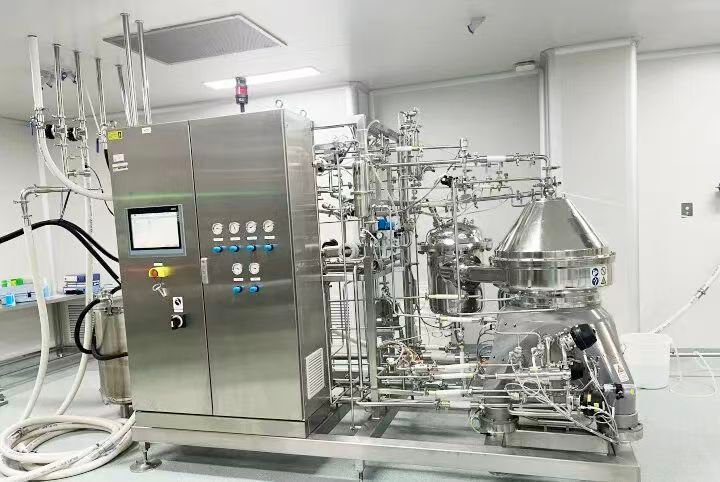
Primary clarification constitutes a foundational unit operation in biomanufacturing, directly determining downstream process efficiency, product purity, and overall production economics. With the rapid advancement of mammalian cell culture and microbial fermentation technologies, high-density cell harvesting has become a mainstream production strategy to boost bioprocess productivity. However, traditional clarification methods, including depth filtration and batch centrifugation, face prominent limitations in high-density broth processing, such as low throughput, high consumable costs, severe cell lysis, and unstable clarification efficacy. Disc stack centrifuges (DSCs) have emerged as a superior primary clarification solution for high-density harvesting by virtue of their high centrifugal acceleration, continuous operation capability, and optimized phase separation structure. This article systematically analyzes the technical bottlenecks of conventional primary clarification processes in high-density bioprocessing, elaborates on the working principle and structural advantages of disc stack centrifuges, and explores their core application values in improving clarification efficiency, reducing product loss, lowering operational costs, and enhancing process scalability. Meanwhile, key operational optimization strategies for DSC-based high-density harvesting are summarized, providing technical references for the industrial upgrading of biomanufacturing primary clarification workflows.
1.Introduction
Modern biopharmaceutical and industrial biomanufacturing industries are increasingly adopting high-cell-density culture (HCDC) technologies to maximize bioproduct yield per unit volume and shorten production cycles. In monoclonal antibody production, recombinant protein synthesis, and microbial metabolite fermentation, cell densities have been significantly elevated compared with traditional culture processes, bringing unprecedented challenges to the primary clarification stage. Primary harvesting and clarification aims to rapidly separate intact cells, cell debris, and insoluble impurities from the culture supernatant while minimizing product loss and intracellular component release, which is critical for reducing the purification pressure of downstream chromatography and filtration processes.
Traditional primary clarification solutions rely heavily on batch centrifugation and single-stage depth filtration. Batch centrifugation features discontinuous operation, low processing efficiency, and poor adaptability to high-solid-content broths, often leading to incomplete solid-liquid separation and frequent equipment downtime for residue discharge. Depth filtration, though capable of achieving fine clarification, suffers from rapid filter medium clogging in high-density broth treatment, resulting in sharply increased consumable consumption, elevated production costs, and unstable batch-to-batch product quality. In addition, excessive filtration pressure and prolonged material retention in traditional processes easily induce cell lysis, releasing lactate dehydrogenase (LDH) and other intracellular impurities, which further complicates downstream purification and reduces final product purity and yield.
As a high-efficiency continuous solid-liquid separation device, the disc stack centrifuge has been widely applied in large-scale bioprocess clarification in recent years. Its unique multi-disc layered separation structure and high-gravity centrifugal field enable efficient separation of fine particles and low-density cell debris in high-viscosity, high-density culture broths. Compared with conventional processes, DSC-based clarification processes deliver higher throughput, lower shear force, better operational stability, and superior scalability, perfectly matching the technical requirements of modern high-density biomanufacturing. This paper focuses on the application advantages and process optimization of disc stack centrifuges in primary clarification for high-density harvesting, providing systematic technical support for industrial bioprocess optimization.
2.Technical Bottlenecks of Traditional Primary Clarification in High-Density Harvesting
2.1 Limitations of Batch Centrifugation
Traditional batch centrifuges operate in intermittent cycles of feeding, separation, sedimentation, and residue discharge. In high-density cell broth processing, the high solid load leads to rapid accumulation of cell sediments in the centrifugal bowl, requiring frequent shutdowns for cleaning and discharge. This discontinuous operation mode severely restricts production throughput and increases manual intervention and production cycle time. Moreover, the uneven gravity field and long material retention time in batch centrifuges easily cause secondary cell damage and lysis, leading to elevated supernatant turbidity and increased impurity content, which compromises the clarification effect. In addition, batch centrifugation exhibits poor batch consistency, with separation efficiency fluctuating significantly under different cell density and viability conditions, making it difficult to meet the standardized production requirements of large-scale biomanufacturing.
2.2 Deficiencies of Depth Filtration
Depth filtration utilizes the porous structure of filter media to trap fine solid particles and cell debris, which is suitable for low-solid-content supernatant polishing. However, when applied to high-density cell harvesting, the high concentration of suspended solids quickly blocks the internal pores of filter media, resulting in a sharp drop in filtration flux and a rapid increase in system pressure difference. To maintain processing capacity, manufacturers need to frequently replace filter elements, leading to a substantial increase in consumable costs and production downtime. Meanwhile, excessive filtration pressure will generate shear stress on fragile mammalian cells, inducing cell rupture and intracellular impurity release. Studies have shown that single depth filtration processes are only applicable to small-scale culture volumes below 4000 L, and their cost and space constraints make them unable to adapt to large-scale high-density bioprocess production.
2.3 Comprehensive Process Pain Points
In addition to the equipment-specific limitations above, traditional clarification processes face universal pain points in high-density harvesting. First, the product recovery rate is low; incomplete solid-liquid separation and process-induced cell lysis lead to a large amount of target products being trapped in sediments or mixed with impurities, resulting in economic losses. Second, the process scalability is poor. Traditional equipment cannot achieve linear amplification in high-density working conditions, and process parameters need to be repeatedly adjusted with the expansion of production scale. Third, the downstream linkage effect is negative. Residual fine debris and intracellular impurities in the supernatant will increase the burden of subsequent sterile filtration and chromatographic purification, shorten the service life of purification media, and increase the risk of product contamination.
3.Working Principle and Structural Advantages of Disc Stack Centrifuges
3.1 Core Separation Principle
Disc stack centrifuges are high-efficiency continuous separation devices based on centrifugal sedimentation theory. The core component is a set of closely stacked conical disc groups inside the centrifugal bowl. When the equipment operates at high speed, a strong centrifugal field (up to 12,000 g or higher) is formed inside the bowl. After the high-density cell broth enters the centrifuge, it is evenly distributed into the narrow gaps between adjacent discs. Under the action of centrifugal force, solid particles such as intact cells and cell debris with higher density are thrown outward along the disc surface and deposited on the inner wall of the centrifugal bowl, while the low-density liquid phase containing target products moves inward and is discharged as clarified supernatant.
The layered disc structure effectively shortens the sedimentation distance of solid particles, significantly improves the separation efficiency of fine particles, and solves the problem of incomplete separation of tiny debris in high-density broths encountered by traditional centrifuges. By adjusting the centrifugal speed, feed flow rate, and solid discharge frequency, DSCs can adapt to cell broths with different cell densities and viscosity, realizing precise control of solid-liquid separation effect.
3.2 Key Structural and Operational Advantages
Continuous stable operation: Different from intermittent batch centrifuges, most industrial disc stack centrifuges support continuous feeding, continuous clarification, and semi-continuous or continuous solid discharge. The continuous operation mode eliminates frequent equipment shutdowns, greatly improves production throughput, and is suitable for long-term stable operation of large-scale high-density harvesting processes. The optimized discharge system, such as the Soft Shot® discharge technology, realizes accurate partial and full solid discharge, avoiding material loss and process fluctuation caused by excessive discharge.
Low shear force and low cell damage: The internal flow channel of DSCs is optimized for smooth flow, which effectively reduces fluid shear stress during material processing. Compared with traditional centrifugation and filtration processes, DSC processing can maintain low LDH activity in the supernatant, indicating minimal cell lysis and intracellular impurity release. This advantage is particularly critical for the clarification of fragile mammalian cell cultures, which can effectively protect the integrity of target products and reduce subsequent purification difficulties.
Excellent scalability and process stability: The DSC amplification principle is based on the constant ratio of feed flow rate to centrifugal gravity, realizing linear process scaling from laboratory small-scale verification to industrial large-scale production. The standardized operating parameters ensure consistent clarification effect and product recovery rate between different production scales, solving the problem of unstable batch quality in traditional processes. In addition, the single-use DSC design effectively avoids cross-contamination between batches, meeting the GMP production requirements of biopharmaceutical products.
High clarification efficiency and product yield: The multi-disc layered separation structure enables DSCs to efficiently remove micron-scale fine cell debris and suspended solids in high-density broths. Practical industrial verification shows that DSC-based primary clarification can reduce supernatant turbidity to a low level, with a product recovery rate of up to 98.5%, which is significantly higher than that of traditional processes. The high-purity clarified supernatant can directly reduce the pressure of downstream fine filtration and chromatography, improving the overall process efficiency.
4.Optimization Strategies of DSC-Based Primary Clarification for High-Density Harvesting
4.1 Parameter Matching Based on Broth Characteristics
The core of process optimization is to match operating parameters according to the characteristics of high-density cell broth, including cell density, broth viscosity, cell viability, and impurity content. For high-cell-density and high-viscosity fermentation broths, appropriately increasing the centrifugal speed can enhance the centrifugal force, improve the separation ability of fine particles, and reduce supernatant turbidity. For broths with low cell viability and more fragile cells, the feed flow rate should be moderately increased to shorten material retention time in the centrifugal field, reduce cell lysis caused by over-centrifugation, and control LDH release. Meanwhile, the solid discharge cycle should be dynamically adjusted according to the solid accumulation rate to avoid incomplete separation caused by excessive solid deposition or product loss caused by frequent discharge.
4.2 Optimized Combination of Continuous Operation Mode
For large-scale continuous high-density harvesting, continuous solid-discharging DSCs are preferred to replace semi-continuous and batch operation modes. The continuous discharge structure can stably discharge high-concentration solid sediments in real time, maintain the stability of the internal separation environment of the centrifuge, and avoid process fluctuation caused by solid accumulation. By configuring a flow control valve and centripetal pump system, the solid content of the concentrated sediment stream can be precisely adjusted, realizing the balance between maximum product recovery and optimal clarification effect. In addition, the linkage control of feed speed and discharge frequency can further improve the automation level of the process and reduce manual operation errors.
4.3 Pre-treatment and Post-process Matching Optimization
To further improve the overall clarification effect, DSC primary clarification can be matched with a reasonable pre-treatment and post-process system. Appropriate broth temperature control and pH adjustment before feeding can stabilize cell state and reduce cell lysis during separation. For ultra-high-density broths, a low-speed pre-separation step can be added to remove large particulate impurities first, reducing the operating load of the disc stack centrifuge and extending the stable operation cycle. After DSC primary clarification, a small-volume depth filtration or membrane filtration polishing step can be adopted to remove residual trace fine debris, realizing high-efficiency and high-purity clarification at a low consumable cost.
4.4 Process Window Visualization and Standardization
Establishing a visualized process operation window is an important means to realize stable and repeatable DSC clarification processes. By taking clarification efficiency, product recovery rate, and supernatant turbidity as core evaluation indicators, the optimal range of operating parameters (centrifugal acceleration, feed flow rate, discharge interval) under different cell density conditions is summarized and quantified. The standardized process window can guide rapid parameter adjustment in industrial production, avoid process deviation caused by manual experience dependence, and ensure batch-to-batch consistency of high-density harvesting and primary clarification processes.
5.Industrial Application Value and Prospect
The application of disc stack centrifuges in high-density harvesting primary clarification has solved the core technical bottlenecks of traditional bioprocesses, bringing significant economic and technical benefits to biomanufacturing enterprises. In terms of economic benefits, DSC continuous operation reduces equipment downtime and manual operation costs, and its high product recovery rate greatly improves the utilization rate of fermentation products. Meanwhile, DSC clarification can significantly reduce the clogging frequency of subsequent filtration media, reduce the consumption of disposable consumables, and effectively lower the overall operational cost (OPEX) of the production line.
In terms of technical benefits, DSC-based clarification processes feature low cell lysis, low impurity release, and high supernatant purity, which can effectively reduce the purification pressure of downstream chromatographic processes, extend the service life of purification resins, and improve the purity and safety of final bioproducts. In addition, the excellent scalability of DSCs realizes seamless process amplification from laboratory research and development to industrial mass production, shortening the process development cycle and accelerating the industrial transformation of bioproducts.
With the continuous development of single-use technology, intelligent process control technology and high-density culture technology, disc stack centrifuges will further evolve towards intelligence, integration and flexibility. The combination of single-use DSC equipment and automated process monitoring systems will realize real-time monitoring and dynamic adjustment of clarification parameters, further improving the stability and controllability of high-density harvesting processes. It is foreseeable that DSCs will become the standard core equipment for primary clarification in modern high-efficiency biomanufacturing, and be widely popularized in monoclonal antibody drugs, recombinant proteins, microbial fermentation products and other fields.
6.Conclusion
High-density cell harvesting is an inevitable development trend of modern biomanufacturing, which puts forward higher requirements for the efficiency, stability and economy of primary clarification processes. Traditional batch centrifugation and depth filtration processes are difficult to adapt to the production needs of high-density broths due to their inherent limitations such as low throughput, high cell lysis and poor scalability. Disc stack centrifuges rely on their unique multi-disc separation structure, high-efficiency centrifugal field and continuous stable operation mode, showing irreplaceable technical advantages in high-density primary clarification. Reasonable optimization of operating parameters, operation modes and process matching schemes can further maximize the clarification efficiency and product recovery rate of DSCs.
The popularization and application of optimized DSC clarification processes can effectively solve the pain points of traditional bioprocessing, reduce production costs, improve product quality and process stability, and provide strong technical support for the high-efficiency, large-scale and standardized development of the biomanufacturing industry. In the future, with the continuous innovation of equipment technology and process optimization strategies, disc stack centrifuges will play a more important role in the upgrading and iteration of bioprocess primary clarification technology.