

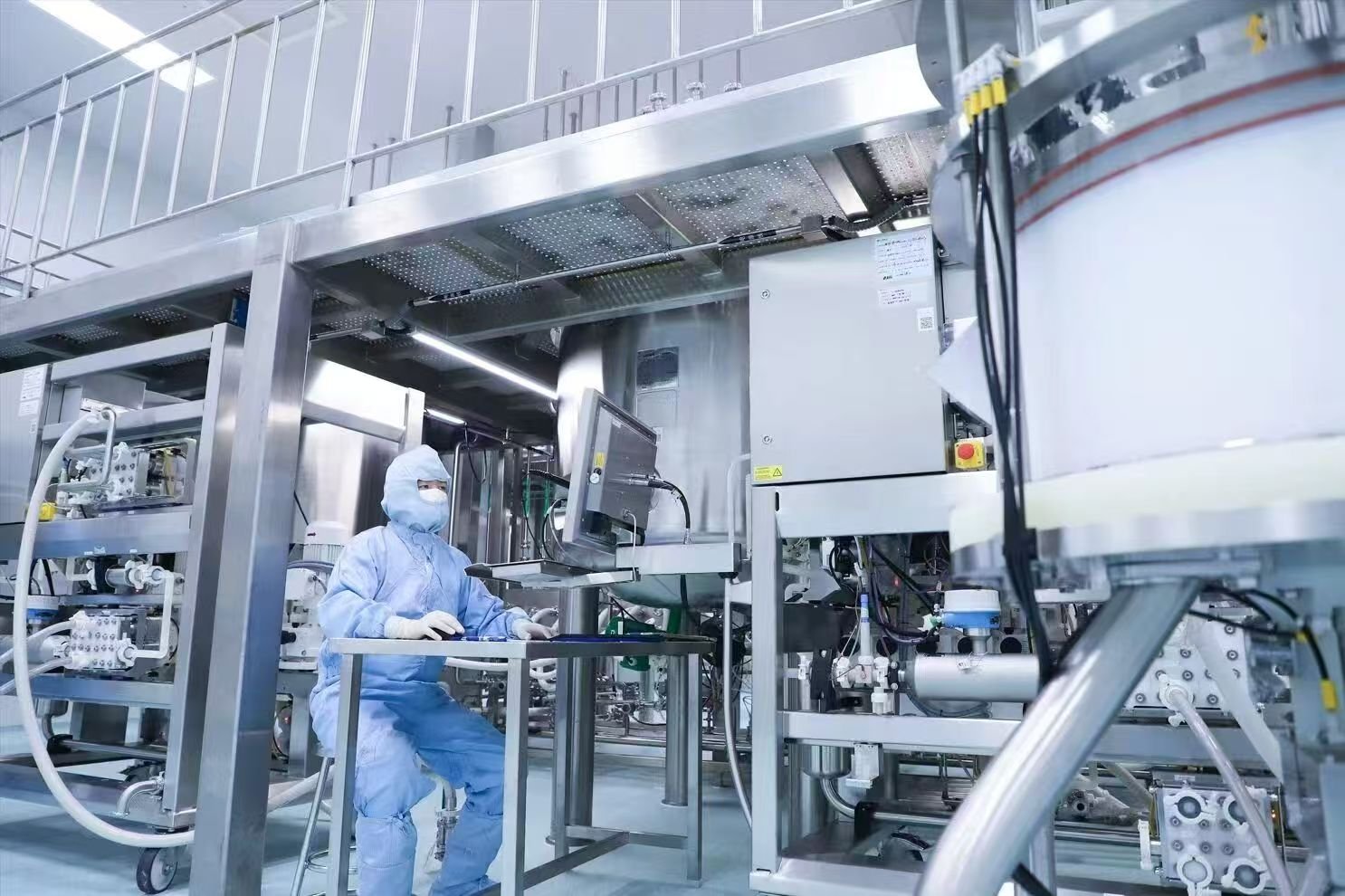
Process intensification, as defined here, is the desire to improve productivity (grams/L/h or grams/gram resin-hr or plant productivity in grams/plant-h). Intensification of a production process is often necessary for a variety of reasons, including the need to mass produce mAbs (e.g., multi-tons/year) to meet patient demand without having to expand existing facilities, or development of high concentration formulations to enable subcutaneous dosing. These can be achieved through the use of higher titer in shorter production time (e.g., use of perfusion system at the N-1 stage), highly concentrated reactants (e.g., buffer concentrates) and intermediates/drug substance (e.g., use of SP-TFF), more compact operating conditions (e.g., higher loading ratios on columns), continuous processing (e.g., Simulated Moving Bed chromatography), and/or combining unit operations into single units (pool-less processing, resin blending). Implementation of these technologies and methodologies can result in a dramatic reduction in the footprint of a process on the manufacturing floor, thereby minimizing investment and resources and potentially improving the speed to market for patients.
If one looks at facility utilization for mammalian capacity, it has been remained relatively constant despite the addition of new pipeline products over the period of 2009 to 2013 due to the substantial titer increases realized across the industry. Looking at current bioreactor capacity and company’s phase 2 and 3 pipelines (including biosimilars), facility utilization is predicted to average about 80% out to 2020. A new 160,000-square-foot biological facility with 15,000L bioreactors requires over 500 employees and was estimated to cost approximately $1 billion USD, forcing companies to continue to innovate to maximize the use of existing facility space.
For those companies using batch or fed-batch bioreactors, improving titers from 5g/L to 10+g/L and downstream process throughput for protein A from 500mg/L/day to 1200–1500mg/L/day are required to avoid having to build new facilities for large mass requirement products. For companies using perfusion technology, continuous improvement in titer and longer run times are putting pressures on cell line development to ensure that genomic stability and product quality can be maintained throughout the culture duration. If successful, these innovations will allow a company to move from making 3.3 metric tons of mAb per year to >10 metric tons per year. Alternatively, one could intensify a process by making it fully or partially continuous downstream.
Process simplification, as defined here, is a technique designed to eliminate wasteful or non-value added actions, reduce process cycle time, and remove disconnections between unit operations. For a process developer, process simplification translates to designing the same process with less effort which can include less manipulations or time within a unit operation, between units, or even eliminate unit operations. Examples include use of a high density cell bank (eliminates manipulations during inoculum preparation), combining two downstream unit operations into one (e.g., substitution of a two-step chromatography with a mixed mode resin), on-column chemical treatment vs. a two-step operation (trisulfide reduction or on-column viral inactivation), or seamlessly blending one unit operation into the next to avoid extra processing (e.g., elimination of in-between step UF/DF, avoid pH/dilution adjustments, intermediate hold tanks). Examples of both intensification and simplification are described in more detail below.
Generation and Cryopreservation of Cell Banks
As each cell culture process begins with the thaw of working cell bank vial, the cell bank generation process is the first step suitable for intensification. A traditional cell culture process would begin with thaw of a vial and sufficient cells to inoculate a small flask of approximately 25–100 mL working volume. Compared to the scale of an industrial production bioreactor, a large scale-up factor remains from this initial thaw, which requires time in the facility and resources to maintain and monitor the culture. A higher cell density cell banking process that ultimately permits a larger working volume at thaw is therefore becoming the standard operating procedure. Tao and coworkers demonstrated a perfusion-based cell banking process resulting in a high density 4.5 mL cell bank containing 100×106 viable cells (vc)/mL that permitted direct inoculation of a 20-L rocking bioreactor. Heidemann and colleagues also utilized a perfusion-based cell banking process but created a larger volume cell bank in a 100-mL cell bag at 20×106 vc/mL. More recently Seth and coworkers created a frozen seed train intermediate that consisted of a 150-mL cell bag at 70×106 vc/mL. The resulting combination of large volume at high cell density allows the cell culture process to begin in an 80 L bioreactor.
The stated intention of these seed train intermediates is simply to supply an individual manufacturing campaign. Based on the volume of cell culture required per bag and the bioreactor size used in this process, a cell bank of over 100 cell bags could theoretically be created.
The latter case of a high density cell bank in a 150-mL cell bag is atypical, and this individual manufacturing step is an extreme case of high cell density. The resulting cell bags require at least two orders of magnitude more cells when compared to a traditional cell banking process. However both the 4.5-mL vial and large volume cell bag are described to save multiple stages and operations within the manufacturing scale up process. Compared to a traditional vialing process, one could intellectually assign the complexity associated with manufacturing a higher cell density cell bank to the first batch. Starting with the second batch, the manufacturing process then uses a simplified manufacturing process, and the payback in reduced labor for a process with fewer stages effectively more than pays for the complexity in making the cell bank. With a recent report achieving over 200×106 vc/mL via perfusion, even larger bioreactors could theoretically be inoculated directly if the cells remain suitable for an industrial-scale cell banking process. Overall the trend in cell banks is clearly in the direction of higher cell densities and higher volumes.
Establishing Platform Cell Culture Solutions
A process with a single basal medium simplifies the entire cell culture process. The medium preparation process is replicated with only gravimetric requirement changes as the scale increases. Maintaining consistency from preparation to preparation should lead to reliable medium with the intended properties for cell culture. Consistent preparations cannot be guaranteed due to the potential for raw material impurities to impact outcomes. The medium must also be optimized for the specific situation as a feed medium in fed batch production is not interchangeable with a perfusion medium. However, by maintaining a single basal, perfusion, and/or feed medium for an entire cell culture platform, a company can establish increased experience and data pertaining to the raw materials required and any potential impurities.
Even without considering raw material impurities, cell culture medium is a complex mixture of approximately 30–50 components including sugars, amino acids, buffers, salts, vitamins, and trace metals. To simplify the preparation, a platform cell culture medium will be created mostly by dissolving a single bulk powder containing accurately proportioned components in water. This step guarantees the precise delivery of a large number of components on the manufacturing floor in a simple way. Additives incompatible with the manufacturing process of this powder may be added after the powder is dissolved. There are a variety of technologies available at cell culture medium manufacturers to create this powder, including pin milling, granulation, and compaction. The benefits of pursuing these cell culture media alternative technologies need to be balanced with the potential for simplification by outsourcing the medium generation and sourcing directly liquid medium.
Defining a single cell culture medium is a critical step to simplify the platform. Recently Roche and Genentech eliminated the differences between the cell culture medium platforms and developed a single cell culture platform. The resulting optimized process delivered an average 30% increase in titer. A process which easily delivers consistently high titers is critical to the business drivers behind development of a platform for monoclonal antibodies. Medium development work may still be required in case of a difficult-to-express protein, or when product quality drivers exist such as the need to alter glycosylation.
Optimizing the Production Bioreactor
A major limitation of production in a facility is the production bioreactor. The production bioreactor process duration (commonly about two weeks for a fed-batch process) is frequently a rate limiting step in an industrial facility, given that all other upstream and downstream process steps require only up to a few days. Consequently, several groups have investigated utilizing perfusion in the bioreactor immediately preceding production. The common net result is higher densities at inoculation of the production stage, shorter process durations, and similar titer and product quality. Thus the production process is even more productive with higher overall facility volumetric productivity. The additional challenge lies in optimizing perfusion medium to generate the necessary cells for the production bioreactor without creating new burdens in frequent, large volume medium preparation in a facility. However, by shifting from a standard vial to a high density vial or high density cell bag and to a perfusion seed bioreactor, many manufacturing steps and days in the process can be eliminated. In totality, approximately two weeks in upstream manufacturing could be eliminated per batch by implementing a high cell density bag. From a different perspective, over 20% increase in overall mAb mass produced could be realized in the same manufacturing facility by implementing the perfusion seed bioreactor.
Production Platform Decision
In a production platform, the key parameters are the cell densities achieved over time and the cell-specific productivity as these values determine the overall cell and product mass generated in the cell culture process. The titer in a fed batch process can be directly described by a two-dimensional contour plot comparing the titer achieved for various integral viable cell concentrations (the area under the viable cell density curve) and the cell specific productivity. On the contour plot, one can overlay lines of constant titer or isotiter curves. The same titer can be achieved by a high cell density and low specific productivity cell line or a low cell density and high specific productivity cell line. However, a titer approaching 20g/L will likely require both a high cell density and high specific productivity. In a perfusion platform, the same type of contour map can be constructed but the perfusion rate becomes a critical variable. While there are various reasons a scientific organization might choose a fed-batch or a perfusion process for a production mAb, one consideration is the antibody mass needed. Of course there are some underlying assumptions in the total antibody mass calculations made per day. For example, a required cell bleed rate that potentially loses product and the required time to achieve the density described in perfusion are ignored in these calculations as is the turnaround time for the production bioreactor in the fed batch over the course of 60 days. In addition, it is conceivable that a cell line may have a different (potentially higher) cell specific productivity in a perfusion system. The intention of this table is simply to spell out the calculation that should be considered before choosing a production platform. When considering the differences between perfusion and fed batch, it is important to remember that the target output is mass, and one of the key inputs is medium. Consequently, titer is diluted in a perfusion system as the perfusion volumes increase, and the key parameter to calculate is the mass produced per liter of medium utilized, rather than the mass produced per bioreactor hold-up volume.
Harvest
Centrifugation, in combination with depth filtration, has been the workhorse for large-scale harvest clarification since the late 1990s. Over the past 10 years, advances in bioreactor development have achieved strikingly high cell densities of over 150*106cells/mL while maintaining reasonably high harvest viabilities of >70%. This combination of high cell mass and associated cellular debris however has required renewed efforts in harvest technology and processing just to maintain yield, product quality, and process throughput.
Pre-treatment clarification technologies, such as acid treatment, addition of flocculants, or precipitation continue to improve such that one can now target not only the cellular debris but also process-related impurities (e.g., DNA, host cell proteins, endotoxin) or even the product itself. Without pre-treatment, the centrifuge packed-cell volumes can approach 15%–20%, which approaches the limits of the centrifuge’s capabilities. Shot intervals (i.e., the length of time between discharges of the concentrated cell mass) and their accompanying turbidity perturbations may be impacted. Nozzles in the centrifuge restrict the flow of the solids/concentrate stream exiting the centrifuge. In a typical disk stack centrifuge, one can achieve a flow rate of about 0.07 L/min per nozzle.
A more recent development in harvest technology is acoustic wave separation (AWS), developed by FloDesign Sonics and licensed to Pall Corporation, for cell clarification and perfusion in the production of immunoglobulins (glycoproteins). This technology, which employs three-dimensional standing acoustic waves to trap cells and cellular debris, forces particles to cluster and settle out of solution. This technology has the potential to reduce particulates in high density cell culture to levels that are more easily manageable for simpler depth filtration. It also would allow for continuous clarification and single-use formats without the challenge of fouling physical filter membranes. Clarification efficiencies of greater than 95% with yields of greater than 85% have been reported.
With respect to product quality, a recent example of increased mAb reduction occurring during harvest intermediate hold has occurred due to increased cell culture densities. This has required developers and manufacturers to implement oxidizing strategies, re-introduce cold temperature downstream processing and/or implementation of charged depth filters to prevent disulfide reduction during harvest.
Protein A Capture
Product capture of mAbs onto Protein A affinity chromatography has been the hallmark choice of purification for decades due to its selectivity for a wide variety of mAbs and Fc-fusion proteins, its robust removal of process-related impurities, high yield (e.g., >90%) and tolerance/interface with a variety of upstream clarified media feed streams. Resin dynamic binding capacity has progressively increased from the 1990s to today from about 20 to 70g/L with the advent of new resin matrices, base stable ligands, higher ligand densities, and less compressible resins. Unfortunately, the cost per liter of resin, however, has not declined over this same period of time, and in many cases has increased. If one examines the changes in binding capacity as a function of cost per L of resin over time, the price has essentially been fairly stable or slightly declining over time. Nevertheless, maximizing the capacity of protein A has generated some intensive development efforts. One example has been to simply implement a dual flow rate loading strategy, whereby a faster flowrate (i.e., shorter residence time) is used in the initial stages of loading (when all the binding sites are available), followed by a reduced flowrate (i.e., residence time increased). This processing method enables additional antibody to diffuse into all the pores and bind to the less readily accessible sites, helping to achieve high capacity while maintaining acceptable processing times. Another example is to increase the number of re-usable cycles of the resin via improved cleaning strategies
A third approach would be to implement a continuous capture approach via either simulated moving bed technologies (sometimes referred to as periodic counter-current chromatography), multi-column solvent gradient purification, or continuous countercurrent tangential chromatography. This later approach, which not only maximizes resin capacity but productivity as well, is getting closer to implementation into commercial processes.
Improving the Downstream Process Productivity (Post-Protein A Capture)
An often-overlooked step in the downstream process are those efforts required to manipulate the feed stream between unit operations. Traditional processing between downstream chromatography steps of an optimized process (i.e., no UF/DF needed to enable further processing) typically consists of collection of the previous eluate pool (or effluent pool if the step is run in flow-through or weak partitioning mode), mixing, load adjustment as needed (e.g., pH adjustment, dilution, and/or salt addition), and additional mixing prior to further processing. Besides those aspects, sampling from each of these steps may also be performed.
One advantage of the traditional processing approach is that it allows some control over the process if decisions are needed between columns to determine how the next step needs to be run (e.g., loading ratio for the next column) along with some modest flexibility in scheduling, assuming stability is established on the intermediate. But how often is this control option (i.e., information) actually utilized in a commercial process?
Additionally, this level of process control can be limited by the process intermediate stability and the overall desire to increase downstream productivity. Taken in its entirety, the between-step processing can be quite cumbersome and labor intensive in that it requires 1–2 collection tanks/bags, 1–2 mixers, 1–2 mixing validations, titration curves (if pH adjustment), stability data, plus manufacturing and/or QC analysis time and resources. Furthermore, the more manipulations there are required between steps, the more chances for even a robust process to undergo a deviation during routine manufacturing. Ideally, if one could develop a process that eliminated at least some of the between-step processing, the benefits could be significant.
Considering the typical downstream platform process for mAbs, one opportunity is between columns 2 and 3, a place where a viral inactivation treatment step typically is not inserted. For example, where AEX and HIC are run in series, the between processing includes both a pH and salt adjustment. Development work using strongly hydrophobic resins such as Hexyl or Phenyl have shown that the need for lyotropic salt addition to the feed of HIC columns can be eliminated whereby the HIC column is now run in the flow-through mode with high molecular weight aggregates retained on the resin. More recent development has focused on enabling in-line pH adjustment to the HIC which can eliminate the intermediate pool.
In collaboration with GE Heathcare, Biogen has been developing a platform on ATKA systems called “straight through processing (STP).” This concept includes a multi-valve system that enables between column in-line adjustment (pH and/ or salt) and mixing. Effluent from the AEX column is passed through an in-line mixer and monitored for UV. A UV signal triggers titration of a load adjustment feed to meet a consistent output pH. Recent laboratory results using this step show that straight-through processing was achievable for several mAbs when the HIC column is used in a binary mode to remove higher molecular weight aggregates and host cell proteins, with or without salt addition. The results were not as favorable for a fusion protein where the subsequent HIC column was run in a bind and elute mode, but this was attributed more to a process that was sensitive to variation.
Overall, the goal of eliminating an intermediate hold tank, improving process throughput and its associated labor was accomplished via straight through processing without sacrificing process control, product yield, or purity.
Polishing Step Improvements
The strategy behind mAb downstream development has traditionally been designed to let the Protein A capture step do the job of removing host cell proteins, DNA, and media components while concentrating the feed stream, to let the downstream polishing steps focus on removal of high and low molecular weight impurities and protein A leachate, and to provide virus clearance. While true in theory, carryover of HCPs and DNA into the Protein A eluate often occur at higher than desired levels, primarily due to complex formation with the target mAb. Thus 2–3 polishing chromatography columns run in a bind and elute or flow through mode comprised of ion exchange and HIC have been the choices for polishing steps. Overall downstream yields typically reach 50% but rarely above 70% in part due to the polishing steps.
Mixed Mode Resins
While resin manufacturers continue to deliver polishing resins of higher capacities and a wider variety of bead and pore sizes, the advent of newer mixed-mode resins from the manufacturers can have the biggest opportunity to streamline the downstream process. Their implementation however has been met with varying degrees of success. On one hand, mixedmode resins are very salt tolerant, can achieve removal of product-related impurities (e.g., aggregates/dimer) with high yield and can provide good virus clearance in a single downstream unit operation. On the other hand, clearance of HCPs has been less robust. Thus, the strategy of replacing two single mode chromatography resins with a mixed mode resin will be case by case depending based on the types of impurities in the post protein A feed stream.
Resin Blending
As one can discern from the above, the key to enabling downstream pool-less processing is to implement in-line mixing that requires only simple single solution adjustment between steps. However, if a process developer can find conditions where no such adjustments are needed between columns (i.e., eluate from one column can be applied directly to the next column), other options beyond pool-less processing open up. One such option is a concept called resin blending, where two (or more) single mode chromatography modalities are blended together and packed into a standard column format. This approach differs from a traditional mixed-mode resin where either two or more different ligands or functional groups are incorporated into a single resin bead. In addition to elimination of intermediate holding tanks and mixing, combining resins into a single column would also eliminate multiple column packing and qualification, multiple skids and filtration, and simplify batch records to further increase productivity and simplicity. Combinations of resins that could be blended together, in theory are limitless, but must function such that parameter variations in one resin don’t affect the other resin’s performance. Often the order of contaminant removal is not sequential, and thus the resins don’t need to be stacked one on top of the other to achieve the same result.
A resin blending experiment was carried out for a high titer mAb using protein A eluate that was neutralized to pH 6.0 or 7.0. One strong AEX resin was pre-blended with a HIC resin and packed into a 5-mL column (0.66×15cm) at a resin blend ratio of 3:4 to match target loading ratios for each resin, respectively. In the control process, both resins were designed to run in the flow-through mode whereby the AEX resin was run at pH 7.0 and the HIC resin was run at pH 6.0.
Product Concentration/Final Formulation
Concentration of the product feed stream, either during or at the end of downstream processing, is often required to alleviate facility tank constraints or reduce final formulation volume, respectively. Traditionally, tangential flow filtration (e.g., UF/DF), which employs membrane modules used in parallel for product concentration and/or diafiltration (Fig. 34.11, panel A) has been the preferred approach. During the UF/DF operation, the product is often over-concentrated beyond the intended target such that a post-rinse of the system enables high yield (i.e., 85%–95%) and is recirculated requiring several pump passes that could result in product denaturation (e.g., aggregate formation). Due to ever increasing demands for higher concentration formulations to enable subcutaneous dosing (e.g., ≥200mg/mL), other process limitations of using UF/DF have surfaced including a significant increase in viscosity (e.g., >50cP) and its accompanying decrease in feed flow rate (i.e. longer processing time). Increasing temperature can decrease viscosity and improve feed flow rates.
More recently, the use of a single pass tangential flow filtration (SP-TFF, Pall Corporation) system has been designed and evaluated, whereby the product is passed through membranes in series (i.e., no recirculation, minimal over- concentration). This could enable a high titer mAb to fit into an existing 15K liter stainless-steel facility via insertion of an SP-TFF post- harvest, post Protein A column and/or during final drugs substance formulation,
As a leading process-oriented engineering company, Sino Bioengineering delivers professional bioengineering solutions and comprehensive technical services to clients worldwide.
For more products and solutions: https://sinobioengg.com/category/solution/
For more service: https://sinobioengg.com/category/service/