

With mass of the antibody and its concentration known at any stage in the process, sizing of a chromatography column can be performed based on both chromatographic and non-chromatographic factors, as well as by considering all the facility and product quality related constraints.
Typically, the column size is chosen following fairly simple guidelines, based on the following set of equations:
where CV is the column/resin volume [L], Loadcycle is the load per cycle [kg/Lresin], including a safety factor to account for feed and resin variability, Massbatch is the mass delivered from a bioreactor [kg], Ncycles is the number of cycles per batch, TimePurif is the total allocated purification time for a single batch [h], and Timecycle is the time for a single chromatography cycle [h].
Eq. yields the volume of packed resin, CV, necessary to purify a given mass within the allocated time. Preferably, the number of cycles should be an integer, as this would mean that each cycle receives the same load. CV can be used to normalize volumes of different solutions used in a chromatography step (e.g., volumes required for buffer or product loading). Use of CV for describing a chromatography method is scale invariant (i.e., the same method can be used at different scales). For instance, 5 CV of buffer can be applicable to whatever CV is utilized, whether in a development laboratory or in a manufacturing facility.
Of course, the size must be chosen in relation to the optimized (at small scale) chromatographic protocol/method and the general scaling principle. As in the case of filtration, some safety factors are used to account for process variability, but these are already established during the process development phase of process design. Although the scale-up guidelines are relatively simple, there are some factors of a non-chromatographic nature that need to be considered to ensure a successful scale-up. The simplest rules for scaling up a chromatography process are based on a direct (linear) scale up. These rules require that bed height, residence time, sample concentration, and gradient volume over resin volume remain constant at all scales. This implies that the scale-up requires sample load, volumetric flow rate, and column cross-sectional area to increase by the same scaling factor.
One drawback of the direct scale-up approach is related to the hardware, as the chromatography columns are available in discrete dimensions, at least from the column diameter perspective, and this fact must be accounted for in all scale-up calculations. As a result, columns are typically slightly oversized, or multiple columns are used.
Per the rules of linear scale-up, increasing column diameter so the column cross-sectional area is increased in proportion to the process volume (keeping the bed height constant) should be enough for a successful scale-up. In practice, however, an increase in column diameter greater than 30cm will lead to a decrease in column wall support for the resin. Depending on the resin type, this effect may vary in magnitude, with resins introduced in the early years of bioprocessing usually being mechanically somewhat less stable. This may, in turn, result in a need to deviate from the highest possible flow for a chromatographic step to minimize bed compression and all chromatographic effects associated with it, namely back pressure. The effect of wall support on compressibility of a packed bed have been investigated in great detail both by academic groups and by industry. When performing optimization of a chromatography step, a constraint on maximum operating velocity after the scale-up needs to be imposed to account for a possible increase of pressure drop over the packed bed in the larger column as a result of these differences between scales.
Therefore, non-chromatographic effects that need to be looked at when performing scale-up include changes in the size of monitoring cell, different lengths and diameters of outlet pipes or tubing, each of which could contribute to larger dilution (zone spreading) in the system. In addition, time delays from valve switching and extra system volumes that would result in a wrong start and finish of pool/fraction collection must be taken into account. Additional factors that will affect process performance after scale-up include changes in sample concentration and composition due to variation in cell culture and buffer quality. The latter is especially true if the buffer composition is complex and based on additives. However, these latter factors can typically be accounted for by decreasing sample size by a safety factor as previously mentioned. Finally, a successful and robust scale-up requires that flow rate, pressure, tank levels, feed concentration, conductivity, and pH need to be monitored continuously.
Although the scale-up is typically done by keeping the bed height and linear velocity constant, other scale-up criteria also exist. One of the most successful ones, especially in the case of monoclonal antibodies purification using Protein A affinity chromatography, is the criterion based on a concept of constant residence time, where the residence time is defined as the ratio of column height, or column volume, to liquid velocity, or flow rate, respectively. In fact, with the constant residence time criterion, it is possible to scale up a chromatographic process at constant productivity while changing both the bed height and the column diameter. Therefore, when scaling up with this criterion, more flexibility in deciding on the right hardware dimensions exists. The principle show that the same residence time can be obtained either for different combinations of column diameters and bed heights at a constant volumetric flow rate, or for different flow rates and bed heights for a constant column diameter.
The constant residence time approach is often used during initial development of chromatography protocols, which is done with small columns to save valuable samples. It could be argued that the concept of scale-up based on the constant residence time is the most general scaling concept in chromatography, providing the separation does not depend on hydrodynamic conditions in the proximity of the surface of a chromatography particle. In the majority of cases, the constant residence time scale-up criterion will hold for heavily loaded columns, gradient, and isocratic elution. In the case of a typical monoclonal antibody purification process, the constant residence time criterion is applicable, especially if one considers all bind elute steps, such as Protein A chromatography, cation exchanges, or HIC steps. However, in the case of convection governed adsorption (the slowest mass transfer step depends on the local velocity as discussed in, the separation may not be the same if the column height is lowered, even though data for identical residence times are compared. However, clearance of critical impurities during a chromatography step operated in flow- through mode may require performing both the optimization and the scale-up applying the constant bed height and the constant velocity criterion (i.e., the linear scale-up). This is especially true when very large impurities such as DNA, viruses, and certain host cell proteins (HCPs) are present in the product stream. Because these large molecules cannot access intraparticle pores of commonly used chromatography resins, the overall rate of their adsorption onto the surface of these resins will be more or less all dependent on the local liquid velocity in the proximity of the surface. Therefore, in case of separations where large molecules are to be adsorbed, to keep the same separation performance at different scales, the residence time should be kept constant, and the liquid velocity should be at least the same as the one used when developing the process. In such cases, the best approach is to perform scaling up based on the constant bed height criterion.
Sometimes, the scale-up based on residence time is also referred to as scale-up on volume basis, where the volumetric flow is defined as multiples of column volumes (CV/h). With this approach, a successful scale up by a factor of 274 was realized, as long as the gradient was appropriately characterized and accounted for at each scale.
As discussed, the criterion of constant residence time is valid for gradient elution, as long as a gradient strength is kept constant in scaled form. In other words, the number of theoretical plates necessary to maintain resolution needs to be kept constant for a given gradient slope. Another scaling principle for linear gradient elution states that resolution is kept constant, provided that the column length increases in proportion to the normalized gradient slope times the height equivalent to theoretical plate for gradient elution. Following this approach, a successful 500-time scale-up was reported. Recently, the same approach was used to design and optimize separation of aggregates from monomer in an antibody purification process.
The rules are given as recommendations that are based on the common understanding of the challenges in mAb purifications and the reported examples. These rules should be applied to each step in a chromatographic cycle (i.e., load, wash, and elution). After all, wash and elution steps are each characterized by their characteristic time constant, and to reach the same efficiency of each step, the ratio of residence time to these characteristic times for each of the steps must not change during scale-up. For instance, it is fairly common to scale up wash and elution steps by keeping the amount of buffer used proportional to column volume and operating these steps at the maximum linear velocity. This ignores the time constant aspect, and such approach may thus result in lower purity and lower process yield if excess of respective buffer is not used once velocity is increased.
No rules for scale-up of clean in place (CIP) are provided, as the cleaning step should typically be based on the contact time during which the resin is exposed to a cleaning solution, making the scale up of this step straightforward.
For a polishing step based on flow-through mode where the remaining impurities are adsorbed on the column and the antibody flows through, the linear scale-up criterion can be recommended as binding capacities, for large-molecule impurities can be dependent on the local velocity in the proximity of the chromatography matrix surface, and, therefore, varying the velocity will affect column performance. In order to determine if this is the case for a specific process, a simple experiment during the optimization phase can be performed in which the separation is compared at two bed heights at the same residence time. If the results obtained differ, a linear scale-up criterion should be used. Of course, as discussed earlier, all the steps can be scaled following the principle behind the linear scale-up criterion.
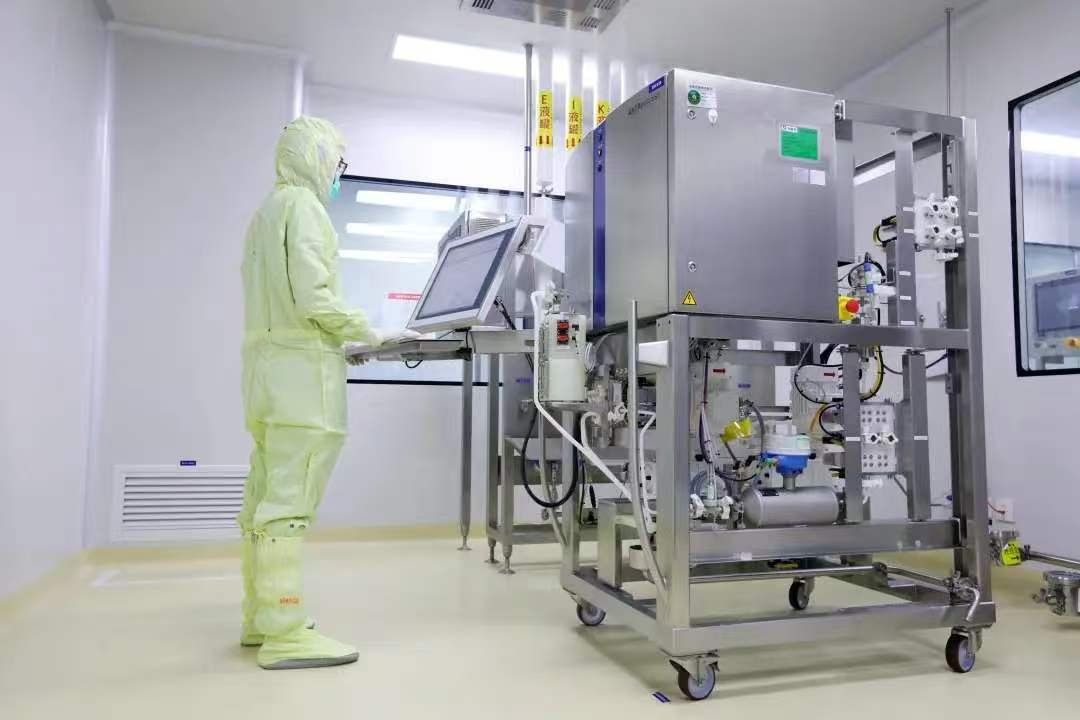
When scaling up a chromatography step, not only a column, but also a chromatography system needs to be considered. Most chromatography column manufacturers offer chromatography systems, either in a standard or a custom-made design. Typically, the chromatography systems are chosen on the flow requirement, and pressure specifications to match desired production rates. The systems are available either in stainless steel, hard plastic, or flexible single-use configurations with varying degrees of automation, as well as expansion capabilities.
Another aspect of scale-up related to hardware design is not immediately obvious, but may cause very practical and costly issues later in the lifetime of a production process. Larger companies with the corresponding experience, and also engineering firms involved in facility design projects, have a tendency of developing their own engineering solutions for chromatography and/or filtration skids. Although this, at times, may look like an appealing option to stay within a tight project budget (these solutions do not carry the cost of a vendor R&D project, nor much SG&A2 costs), they should be very critically reviewed from a medium- to long-term cost of use perspective. For instance, seamless maintenance, and possible production expansions, including transfer to other production sites, either owned or CMO owned, are all affected by nonstandardized engineering solutions. The simplest solution to these problems is the possibility of working with vendors on a custom designed chromatography skid. Such skids are designed based on customer specifications, but are made of standard and proven components, tested extensively in the system vendor R&D program. Thus, scale-up decisions on hardware have certain managerial, long-term aspects to them as well.
However, regardless of the systems design, an important route to achieve a long lifetime of a resin packed into a column, thus minimizing the need for column repacking, is to make sure that nothing accumulates on the packed bed or the column parts that disturbs performance over time. This can be achieved by making sure that the feed applied on the column is as clean as possible, for instance, by applying column pre-filters, and/or by performing efficient and regular cleaning-in-place steps. These preventive maintenance measures of the use of pre-filters and cleaning in place should be developed to prevent column fouling early during the process development phase, almost co-currently with the development of cell culture conditions, by systematically looking for possible solutions, either based on heuristic information, or newly observed phenomena.
As a leading process-oriented engineering company, Sino Bioengineering delivers professional bioengineering solutions and comprehensive technical services to clients worldwide.
For more products and solutions: https://sinobioengg.com/category/solution/
For more service: https://sinobioengg.com/category/service/