

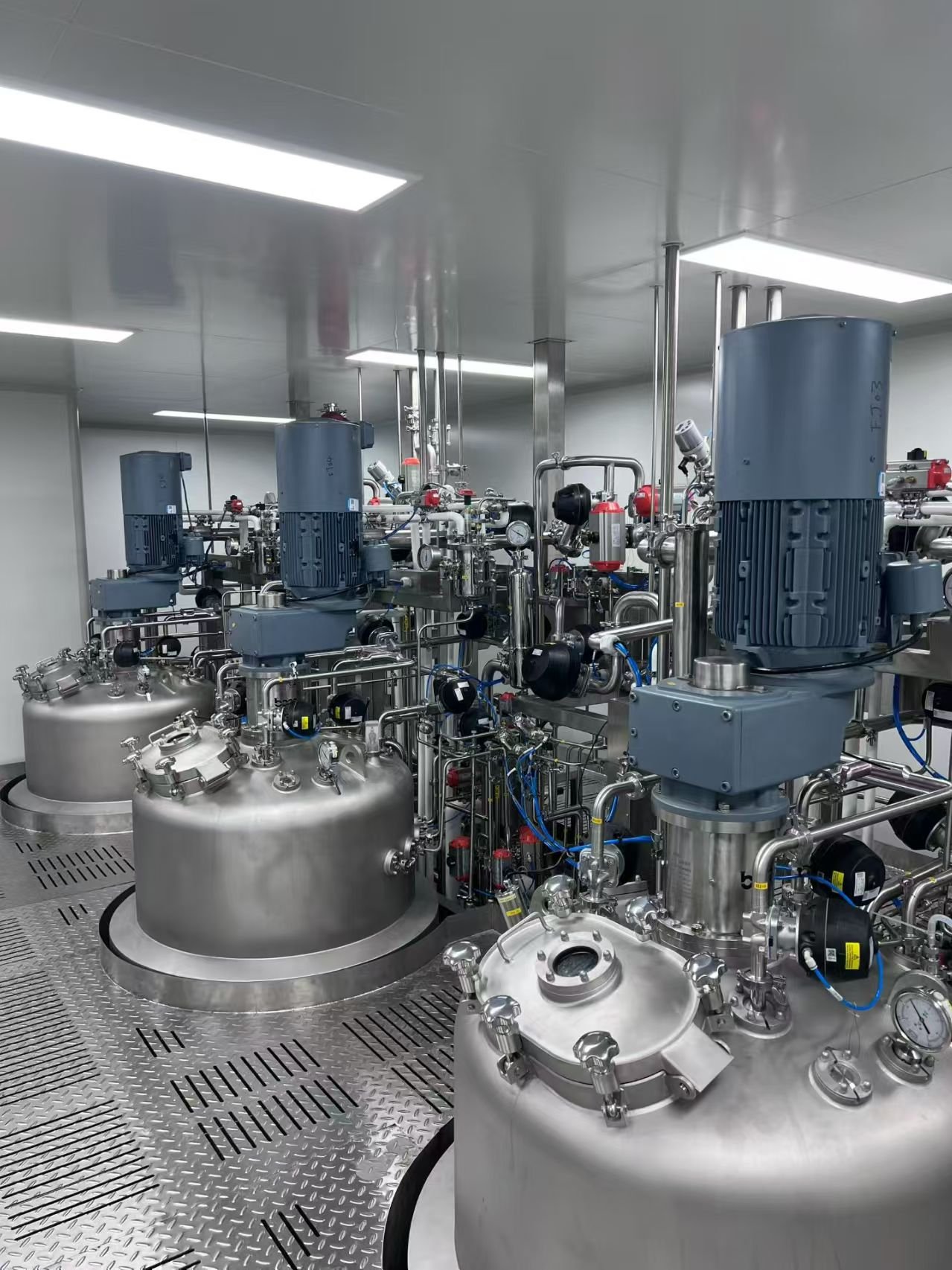
In the biopharmaceutical industry, successful scale-up of laboratory-scale cell culture processes to manufacturing scale represents a major technical bottleneck for the industrialization of biopharmaceuticals such as monoclonal antibodies. This procedure is not a simple geometric proportional amplification, but a complex systems engineering involving fluid mechanics, mass/heat transfer, and cell biology. Among these aspects, evaluating and controlling the potential shear damage to cells is the core challenge to guarantee cell viability and consistent product quality during scale-up. Based on relevant literature, this paper systematically discusses bioreactor scale-up strategies based on shear stress evaluation.
Core Contradiction in Scale-Up: Homogeneity vs. Shear Stress
Establishing a cross-scale cell culture process first requires maintaining scale-independent constant parameters including pH, temperature, and dissolved oxygen (DO). However, parameters such as agitation speed and aeration rate exert nonlinear effects and are highly scale-dependent. The fundamental contradiction of scale-up lies in: sufficient mixing and mass transfer (generally requiring higher energy input) must be provided, while excessive shear stress that damages fragile mammalian cells must be avoided.
Shear stress mainly originates from mechanical energy input by impeller rotation and bubble motion induced by aeration. Studies have shown that mammalian cells are large, cell wall-free, and highly shear-sensitive. Kinetic energy transferred from impellers to culture medium is eventually dissipated as heat and generates velocity gradients in fluid, which are proportional to the energy dissipation rate (EDR). Accordingly, EDR is widely adopted as a proxy indicator for shear stress assessment and a key consideration in process scale-up.
Multidimensional Assessment of Agitation-Related Shear Stress
Quantitative evaluation of agitation-induced shear stress cannot rely on a single parameter, but requires multidimensional analysis from global to local scales.
Volumetric Power Input (P/V): Classic yet Limited Global Indicator
Volumetric power consumption (power per unit volume) is the most extensively used scale-up criterion. To preserve cell viability, bioreactors are generally operated at P/V ≤ 50 W/m³. Nevertheless, P/V is a global average value that masks uneven shear stress distribution inside reactors. Research indicates that up to 70.5% of agitation power is consumed in the localized region near impellers, meaning cells in this area endure far higher shear stress than the average calculated from P/V.
Local Shear Stress Assessment: Key to Understanding Heterogeneity
Given the limitations of P/V, evaluation of local shear stress is essential. Maximum local EDR in the impeller zone more accurately reflects the peak energy exposure of cells adjacent to impellers. Impeller tip speed is another common parameter; excessive tip speed (generally recommended below 1.5 m/s) may cause cell damage. Kolmogorov eddy length scale is a profound indicator for shear damage assessment from the perspective of turbulent microstructures. When the minimum eddy size is smaller than or equivalent to mammalian cell size (<20 μm), shear stress imposed by eddies is sufficient to damage cells. Therefore, process design shall ensure eddy length scale > 20 μm.
Systematic Analysis of Aeration-Related Shear Stress
Aeration not only supplies oxygen but also generates bubbles as a major source of shear stress. In fact, it has been recognized since the 1980s that bubbling-induced shear stress is substantially higher than agitation-derived shear stress.
Bubble Generation and Rising Phases
Excessively high gas velocity at sparger holes (>30 m/s) directly damages cells. The hole Reynolds number should be controlled below 2000 to avoid unfavorable jet flow regimes. During bubble rising, a wake vortex forms behind bubbles; if the EDR-derived micro-eddy scale in this region is smaller than cell size, cell injury will also occur.
Bubble Breakage Phase: Primary Source of Cell Damage
Studies reveal that most cell death in bioreactors arises from shear stress generated by bubble rupture at the liquid surface. Cells entrained in liquid films are violently torn during bubble collapse. Simulation of bubble breakage demonstrates that it induces extreme shear stress at the level of 10⁸ W/m³. Surfactants such as Pluronic F68 added in modern culture media prevent cell adhesion to bubbles, thereby protecting cells during bubble rupture. Experiments confirm that Pluronic F68 addition completely inhibits bubble-related cell death.
Establishment of Cell Viability-Centered Shear Stress Design Space
Traditional P/V and volumetric aeration rate (VVM) are easy to operate but ignore the critical impact of local shear heterogeneity on cell health. Thus, modern bioprocess development requires a comprehensive shear stress design space.
This design space integrates multidimensional assessment metrics:
1. Global constraints: Upper limit of P/V (e.g., 50 W/m³)
2. Local & micro constraints: Impeller tip speed (<1.5 m/s), sparger hole gas velocity (<30 m/s), hole Reynolds number (<2000), and Kolmogorov eddy scale > cell size (>20 μm)
3. Bubble breakage risk management: Optimized sparger selection and cytoprotective agent addition
Trade-off analysis is mandatory during design space application. Reducing agitation speed lowers shear stress but may compromise mixing efficiency and oxygen transfer rate; reducing aeration rate mitigates bubble-induced damage but impairs oxygen supply and CO₂ stripping. CO₂ accumulation is a frequent issue in bioreactor scale-up. Oxygen and CO₂ differ by an order of magnitude in solubility in culture media, leading to frequent imbalance between oxygen supply and CO₂ removal. Research shows that microbubble spargers deliver high oxygen transfer efficiency but insufficient CO₂ stripping capacity, which limits achievable cell density.
Scale-Up Principles Centered on Intrinsic Parameters
Due to poor comparability of operational parameters across different bioreactors, intrinsic fundamental parameters are recommended for cross-vessel and cross-type comparison. Successful bioreactor scale-up requires two parallel investigations: identifying cell tolerance thresholds for each intrinsic parameter, and characterizing correlations between operational (apparent) parameters and intrinsic parameters.
Scale-down models are indispensable for investigating cell tolerance. For instance, under simulated high-shear environments, antibody glycosylation of CHO cells is the most shear-sensitive quality attribute in antibody production. When shear stress exceeds 7.0×10⁴ W/m³, significant alterations in antibody glycosylation occur, with decreased G0 glycoform proportion and elevated G1/G2 glycoform levels. This finding indicates that shear stress insufficient to affect cell growth and antibody titer may still alter product quality.
Successful scale-up of cell culture bioreactor processes requires engineers to transcend simple geometric similarity and parameter invariance principles, and deeply understand and quantify shear generation mechanisms and their cellular impacts. By comprehensively applying analytical tools ranging from average P/V and local EDR to macroscopic tip speed, microscopic eddy scale, and full-chain analysis of bubble generation to rupture, a robust design space centered on cell protection while satisfying process mass transfer requirements can be established. With advances in experimental techniques, computational capabilities, and deeper insights into cellular metabolism and signaling networks, bioreactor scale-up research will witness new developments, enabling more evidence-based process scale-up.
As a leading process-oriented engineering company, Sino Bioengineering delivers professional bioengineering solutions and comprehensive technical services to clients worldwide.
For more products and solutions: https://sinobioengg.com/category/solution/
For more service: https://sinobioengg.com/category/service/