





As the National Medical Products Administration (NMPA) accelerates its accession to the Pharmaceutical Inspection Co-operation Scheme (PIC/S), China’s pharmaceutical regulatory system is advancing toward full alignment with global top-tier GMP standards. As the authoritative global framework for unified pharmaceutical inspection and regulatory mutual recognition, PIC/S establishes stringent, harmonized quality criteria, serving as an indispensable credential for pharmaceutical products to access the global marketplace.
Highly synergistic with PIC/S requirements, the 2023 revised version of EU GMP Annex 1 — the global gold standard for sterile pharmaceutical manufacturing — is fully benchmarked against the draft revised appendix for sterile drugs in China’s Good Manufacturing Practice for Pharmaceuticals (2010 Revision). It imposes standardized, enforceable and practically implementable requirements for aseptic filling processes, covering Contamination Control Strategy (CCS), full lifecycle risk management, data integrity, and maximal sterility assurance, which have become the core compliance benchmarks for sterile pharmaceutical equipment.
The aseptic filling integrated line serves as the core process equipment for sterile dosage form manufacturing and constitutes a critical barrier against particulate, microbiological and endotoxin contamination. The inherent design compliance of such production lines fundamentally determines the feasibility of passing PIC/S and EU GMP dual regulatory audits, and underpins pharmaceutical quality consistency and patient medication safety.
Centering on EU GMP Annex 1 and domestic GMP sterile manufacturing specifications, this paper elaborates on the systematic design considerations and validated engineering solutions embedded in Sino Bioengineering’s vial filling lines at the design phase. The core research dimensions cover five key regulatory priorities: prevention of product contamination, mix-ups and cross-contamination; systematic control of particulates, microorganisms and endotoxins; first-pass unidirectional airflow assurance; and reliability of full-process aseptic transfer and assembly operations.
Universal Design Principles for Full-process Compliance Covering Washing, Depyrogenation, Filling and Capping
Sino Bioengineering’s vial filling integrated lines adopt a core design philosophy of easy sanitization, minimal dust accumulation, inherent contamination prevention and low-maintenance configuration. The entire production line adheres to unified high-standard compliance specifications throughout all process units, with detailed design principles as follows:
The process layout of the production workshop reserves sufficient operational and maintenance clearance on both sides of all equipment, prohibiting single-sided wall-mounted installation. This design meets the requirements of regulatory inspection, daily cleaning and equipment lifecycle maintenance. All equipment contact surfaces are smooth, free of dead spaces, grooves, liquid pooling and dust deposition. Adopted materials feature excellent corrosion resistance, zero extractables and leachables, and compliant biocompatibility for pharmaceutical production. All utility piping is engineered without dead legs, recessed structures or unsealed openings, with externally accessible surfaces for routine cleaning and disinfection, fundamentally mitigating latent contamination risks at the equipment installation stage.
Vial Washing Machine: Barrier against Particulate Residues and Secondary Contamination
As the front-end core process of the entire production line, the performance and structural design of the vial washing machine directly determine the particulate load and cleanliness baseline of subsequent processes. Sino Bioengineering adopts targeted optimized designs to eliminate latent contamination risks:
A non-extensible robotic vial flipping mechanism is deployed to achieve physical isolation between classified and unclassified zones, effectively eradicating cross-contamination caused by cross-region operation. Spray nozzle guide sleeves are omitted where mechanical stability permits, eliminating friction-induced particulate generation from structural origins. Threaded connections of spray nozzle manifolds and individual spray nozzles are structurally optimized to isolate threaded parts from process media, avoiding dirt accumulation and residual medium retention. The drainage system adopts sanitary stainless steel piping with low residual volume, featuring easy disassembly and in-depth sanitization. For scenarios with prolonged open exposure between the final air-drying station and tunnel depyrogenation oven, a Restricted Access Barrier System (RABS) is equipped to isolate ambient air and prevent secondary particulate contamination.
Tunnel Depyrogenation Oven: Graded Pressure Differential Control, Sterilizable Cooling Section and Precise Particulate Management
To satisfy stringent thermal stability and aseptic protection requirements specified in EU GMP Annex 1, Sino Bioengineering’s tunnel depyrogenation oven adopts a high-compliance modular design:
A stable pressure differential gradient of no less than 10 Pa is maintained among the preheating zone, high-temperature depyrogenation zone, cooling zone and background cleanroom, ensuring consistent and directional unidirectional airflow. The cooling section is equipped with in-situ sterilization functionality for non-terminally sterilized products, fully complying with Annex 1 aseptic control criteria. An integrated mesh belt ultrasonic cleaning system is configured to sustain particulate cleanliness within the Grade A airflow zone. Negative pressure sealing technology is applied to isolate the Grade A core zone from external ambient contamination. Surface coolers are structurally separated from HEPA filters to eliminate condensate-induced cross-contamination risks. The bellows structure of air-tight isolation doors features a fully smooth, dead-space-free design for effortless sanitization. The overall equipment architecture is optimized to facilitate HEPA filter integrity testing and full-range validation activities, supporting full lifecycle quality verification and regulatory traceability.
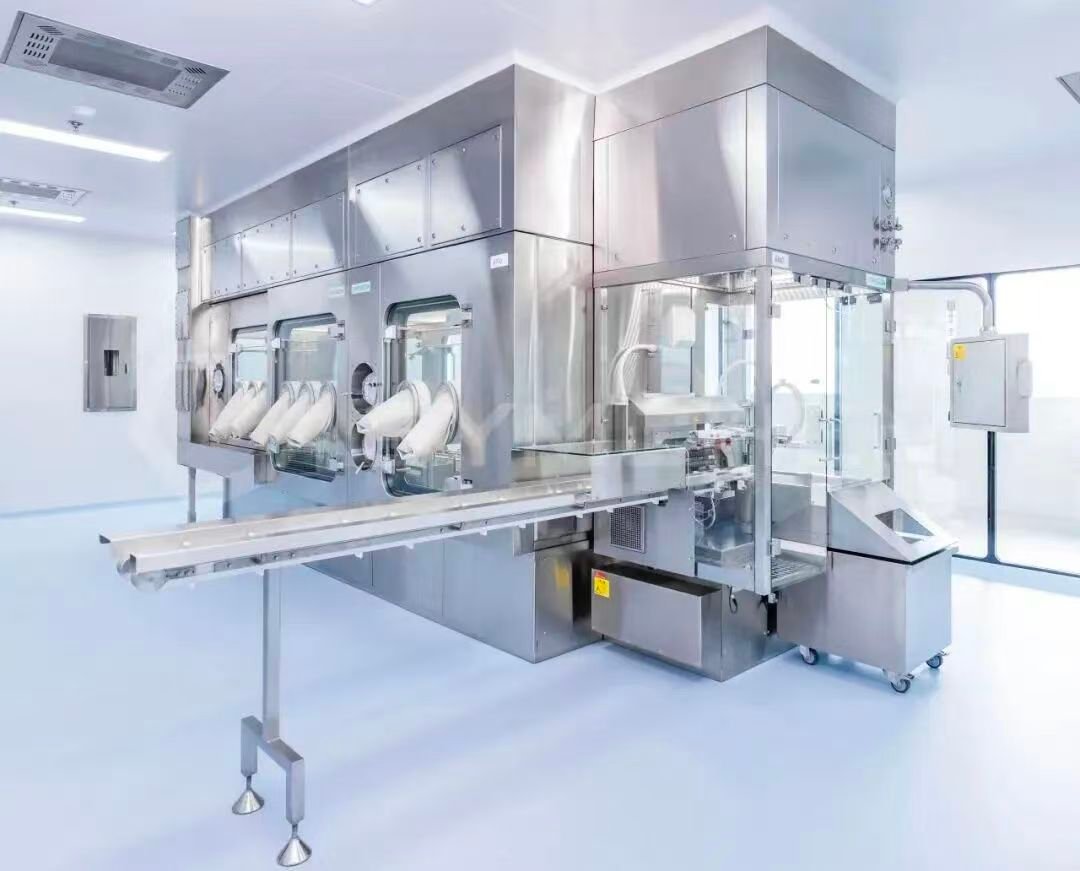
Non-terminally Sterilized Filling Machine: Streamlined Grade A Zone Structure with Dual Safeguards of First-pass Airflow and Aseptic Assembly
As the most rigorously audited core unit in Annex 1 regulatory inspections, the filling machine is designed by Sino Bioengineering with the core objectives of simplifying Grade A zone mechanical complexity, optimizing first-pass unidirectional airflow, and upgrading full-dimensional sterility assurance:
Redundant functional structures are eliminated to minimize mechanical components within the Grade A zone, reducing aseptic contamination probability from the source. The internal layout abandons large-area shielding structures, adopting hollowed-out flow-guiding configurations to ensure vertical, unobstructed and uniform unidirectional airflow coverage. No shielding components are arranged above vial openings and rubber stoppers; all unavoidable structural parts are designed to be detachable and steam-sterilizable. The structural layout is coordinated with isolator return air systems to realize uniform VHP decontamination and eliminate sterilization dead spots.
Priority is given to integrated in-line CIP/SIP systems to achieve verifiable cleaning and sterilization effects, traceable process parameters and sustainable steady-state sterility. The equipment supports PUPSIT (Post-Use Pre-Sterilization Integrity Test) for terminal sterile filters. Components unavailable for CIP/SIP treatment adopt pre-sterilization pre-assembly processes to reduce on-site aseptic operation in the Grade A zone. The nitrogen blanketing system adopts sterile quick-connect fittings to simplify aseptic assembly procedures and stabilize Grade A aseptic environment. A vacuum-free design is preferentially applied to avoid sterility hazards derived from vacuum systems; where vacuum functionality is structurally necessary, a complete set of vacuum pipeline sterilization and risk control schemes is embedded.
Capping Machine: Closed-loop Control of Particulates, Dual-station Rejection and Aluminum Scrap Collection
The capping process directly affects finished product sealing integrity and particulate cleanliness. Sino Bioengineering adopts refined risk-matched design specifications for capping systems:
Hierarchical design for aseptic capping and clean capping scenarios is implemented to match differentiated risk control requirements. Clean capping units are equipped with dual visual inspection systems for stopper seating integrity, improving detection accuracy and reducing manual judgment errors. A dual-stage rejection mechanism (pre-capping and post-capping rejection) is integrated to realize classified elimination of non-conforming products. A dedicated aluminum scrap collection system is configured to effectively control particulate generation and diffusion during capping. The hopper volume and structural layout are optimized to moderate aluminum cap stock volume and vibration duration, preventing cap deformation and concomitant particulate production.
Conclusion: Design-led Compliance to Empower PIC/S and Annex 1 Standard Upgrading
Under the dual regulatory framework of EU GMP Annex 1 and China’s domestic GMP standards, the core competitiveness of modern aseptic filling lines has transcended basic production functionality, evolving into full-dimensional compliance capability centered on contamination control, supported by complete data integrity, and targeted at sustainable sterility assurance. With the formal advancement of PIC/S accession and continuous upgrading of global GMP specifications, pharmaceutical manufacturers and equipment suppliers must adhere to the core principles of front-loaded compliance design, whole-process risk prevention and controllability, and full verifiability throughout the equipment lifecycle.
Sino Bioengineering strictly takes EU GMP Annex 1 as the fundamental design guideline, translating abstract regulatory requirements into executable, auditable and stable industrial engineering solutions. Committed to delivering high-standard, high-reliability sterile filling equipment for the global pharmaceutical industry, the company empowers enterprises to adapt to the new era of global regulatory mutual recognition, stabilize product quality consistency in international regulatory scenarios, and guard patient medication safety with rigorous engineering quality.
